



Active Time is any point where the timings in an Encounter/Scene require moment-by-moment decisions to occur to resolve it. The most common use if for combat Encounters, however, it could be used for determining order of actions for a Party Challenge or when a Character is falling from a great height.
The common aspect for all Active Time events, is calling of Initiative, which requires every Character to make an Agility or Intuition Test, chosen by each Character based on if they are relying on their reflexes or awarenesss to determine how quickly they react to the situation. A GG may decide to roll a single Initiative roll for a group of NPCs with the group taking a simultaneous Turn.
Skills and other Traits may be used, if the Player has an interesting idea for the GG how it helps in the moment, especially if it is in keeping with the scenario of the Scene or the actions the Character was performing just before the Test was called. For example if Initiative was called because of a Character casting a spell, that Character could argue that their Spell Attack Roll be used for their Initative Test, whilst a Character leaping into the fight could argue they be able to use the Acrobatics Skill, and another could use the Empathy skill as they read their opponent to determine when they would draw their Weapon.
In the event of a tie, unless stated otherwise in an entity's Stat Block, Player Characters always win a tie. If two different NPCs have the same result, then they should compare their Traits used for the Test, with the higest results going first, if they are also the same then they reroll their Tests to determine who goes first between them. If two different Player Characters have the same result, they can instead take their Turns simultaneously weaving their actions between each other as they choose.
The result will determine the order of play for each Turn going from the highest Initiative result to the lowest, this is known as the Initiative Order or Turn Order. Once the Turn Order has been established but before any actions occur, any Character may swap places with another willing Character in the Initiative Order. After this unless a specific ability says otherwise the Turn Order will remain unchanged until the end of the Encounter/Scene.
A Round is made up of a number of Turns, each Round taking 6 Seconds in real time. Once every entity involved in the Active Time has had their Turn then a Round is complete, and a new Round behins. For most effects that have a Round as a Duration it will last from when it was used on the current Turn, until the start of the next Turn of the entity whose Turn it was initially used in.
Any number of entities can enter an Active Time ENcounter part way through by rolling Initiative and entering the appropriate space in the Turn Order. In the event of a tie with an entity already involed in the Encounter, the newcomer automatically goes after the other entities they are tied with. If they rolled a higher Initiative than the current Turn in the Turn Order, then they will not have a Turn until the next Round.
If the Initiative is called for combat, before making the Initiative Test rolls, the GG will determine if anyone involved is Surprised. Anyone deemed thus gains the Surprised condition before the Test is rolled.
At the start of each Character's Turn, they reset their Action Points (AP) and Reaction Points (RP), which for most Characters will be 3AP and 1RP. Every action has an associated AP cost, and each reaction has an associated RP cost. If the Character does not have sufficient AP or RP, they cannot perform the action/reaction.
They may perform an action multiple times on the same Turn, when they do so for each time the action was performed after the first that Turn, the AP cost of the action is increased by 2AP.
Once a reaction has been performed, it cannot be performed again until the start of the Character's next Turn.
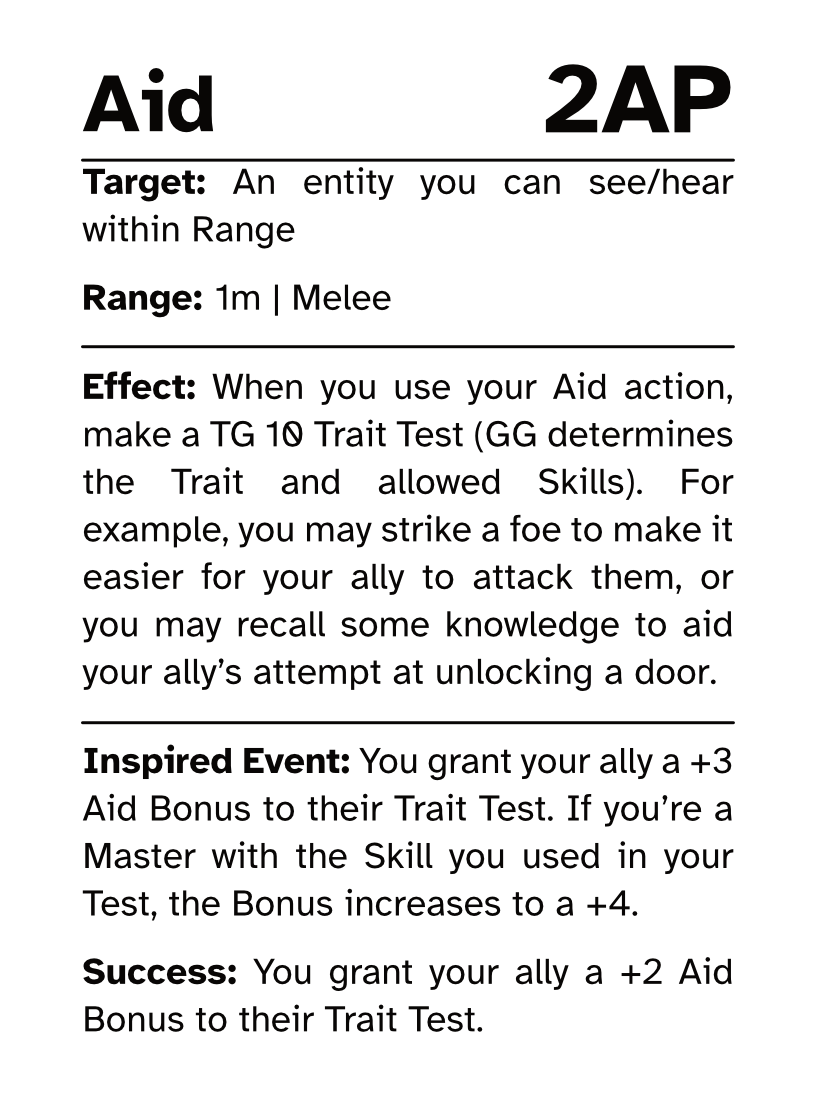
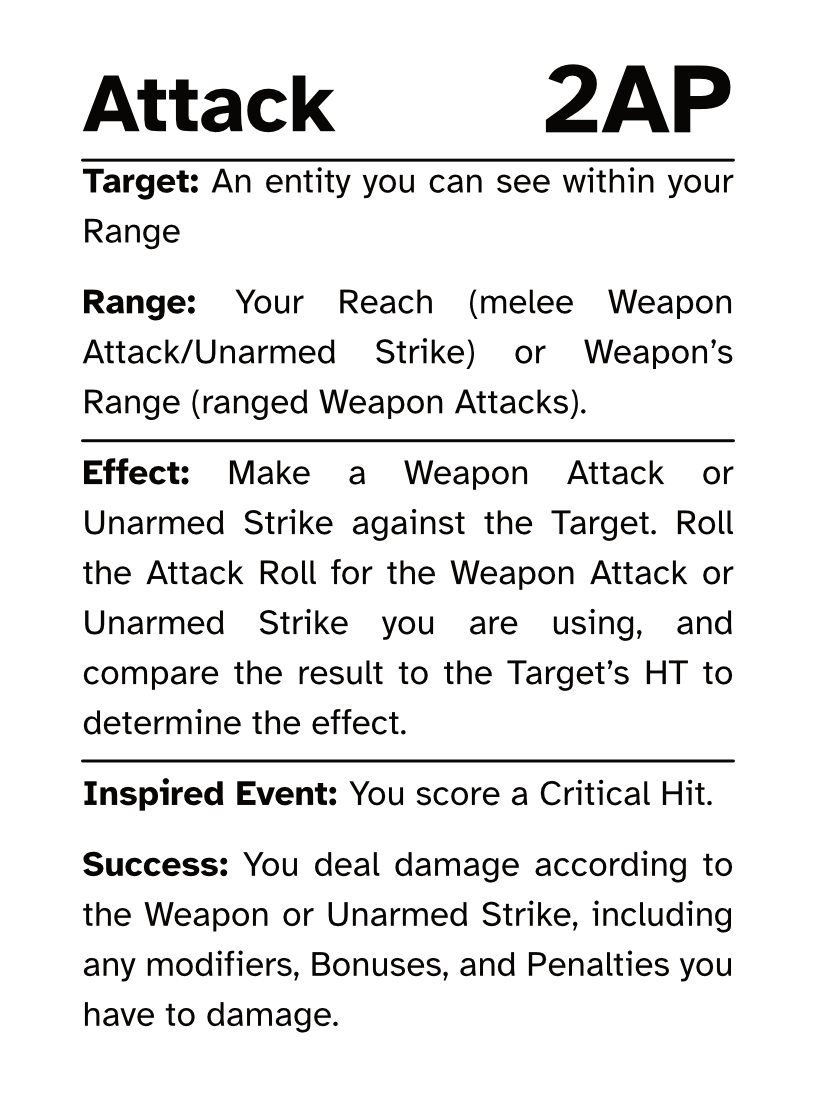
The following are commone actions avalable to all entities in an Active Time Encounter. other actions may be provided by Ancestries, Templates, Class Features, Feats, or Items.
However, you may find that in Narrative Time some of these actions can be used if they do not involve combat (such actions would instead Trigger an Inititative Test), if you are unsure ask the GG if a certain action could be used in Narrative Time.


![Action Card Mark AP Cost: 1AP Effect: When declaring an action involving an Attack Roll, you can use this action simultaneously to Mark the Target if the Attack Roll hits. On a Hit: The Target gains the Marked [Marking Character’s Name] condition, some Class Features and abilities have special effects against Targets that have this condition.](../../images/Action Cards/General Actions/Mark.png)
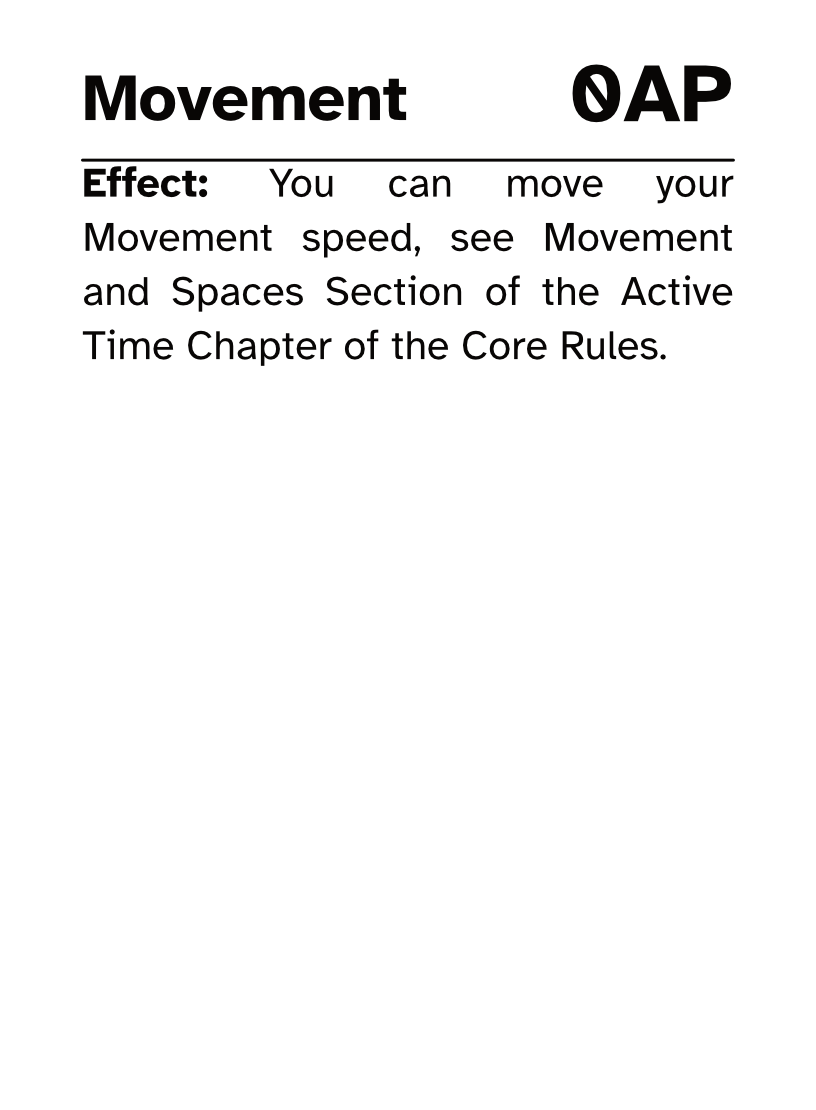

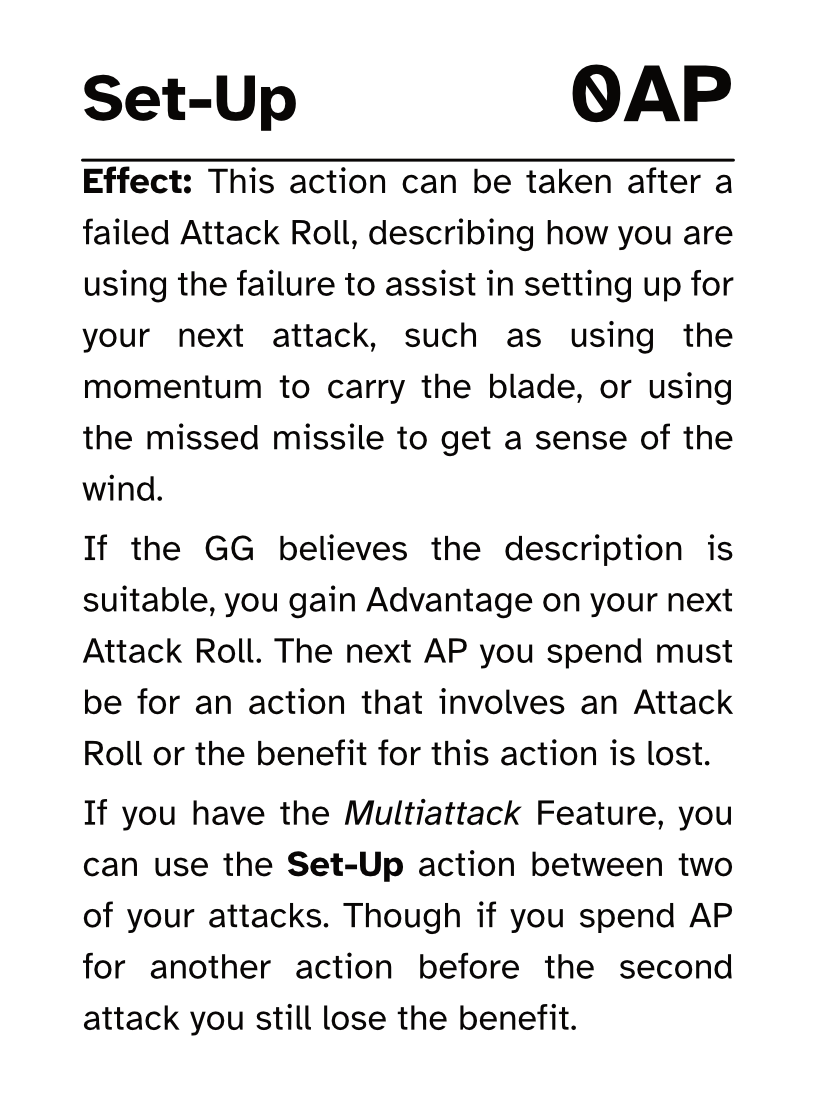
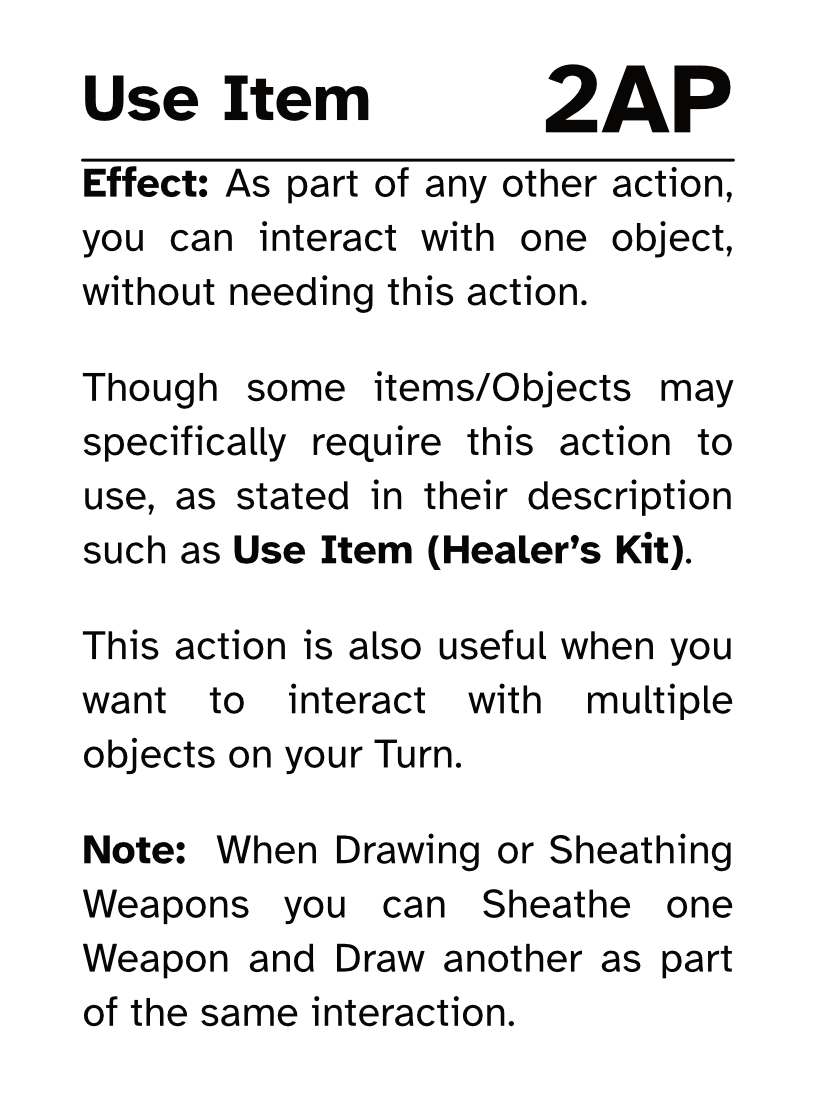
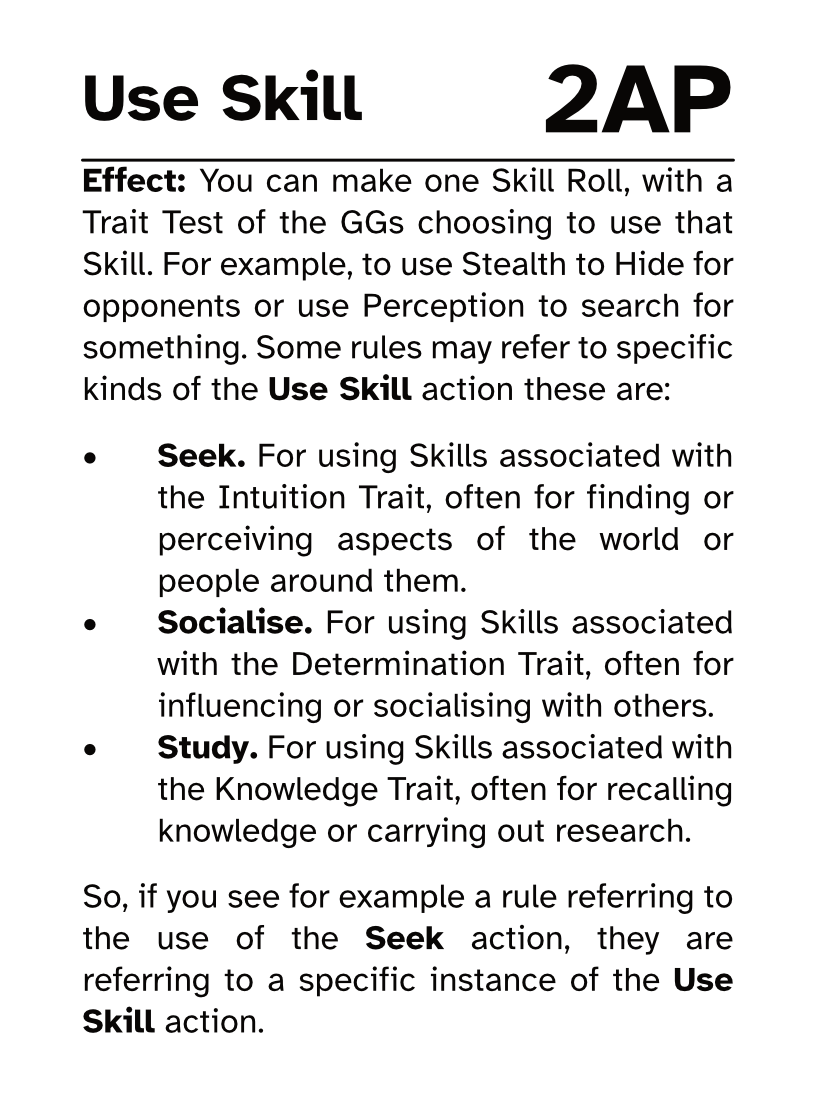

On a Character's Turn they can take the Movement action. When they do so, they can move a distance equal to their Movement speed, they can use as much or as little of their speed as they like on their Turn, following the rules presented in this section.
Their movement can include Jumping, Climbing, Swimming, and more unusual types of movement. These different modes of movement can be combined with Walking, or it can be their entire move. However, they choose to move, they deduct the distance travelled from each part of their movement from their Movement speed until it is either used up or until they are done moving. Whenever they would switch between speeds, such as their Walking speed and Swimming speed, subtract the distance travelled with their initial speed from this new speed. The result determines how much further they can move. If the result would be 0 or less, then they cannot use the new speed during the current Movement action.
They can pause the movement to perform other actions before continuing their movment, if they take the Attack action they can choose to move in between each attack made as part of the action.
Combat has some slight differences over the normal Difficult Terrain rules in the Exploration & Travel Chapter. Every metre of movement in Difficult Terrain costs 1 extra metre. This rule is true even if multiple sources in a space count as Difficult Terrain.
The space of another entity whether hostile or not, also counts as Difficult Terrain.
When Flying if a Character attempt to increase their altitude, they are treated as moving through Difficult Terrain, however, when diving to a lower altitude with their Flying speed, for every metre they move it costs them 0.5m of their Flying Speed.
Whilst Flying, if they do not have the ability to Hover, they must move at least 1m of their Flying speed on each of their Turns to avoid Falling.
You may find yourself often lying on the ground, either because you have been Knocked down, say by the charge of a Minotaur or the swing of a Giant's Club, or because you thrw yourself down to avoid a swinging log trap or the previously mentiopned Giant's Club. In the game, whilst lying on the ground you are considered Prone with the effects listed in the Prone condition. You can drop Prone without using any of your Movement speed.
Standing up, however, takes more effort; doing so costs 3m of your Movement speed. You can't stand up if you don't have enough movement left, or if your speed is 0m. Standing up also will allow for others to make an Opportunity Attack against you.
To move whilst Prone, you must crawl or use supernatural means such as teleportation. Every metre of movement whilst crawling costs an extra 1 metre, this means crawling 1 metre in Difficult Terrain will cost 3m of movement.
Jumping takes place as part of your general movement; Long Jumps may be needed for say jumping over a running river or a chasm, whereas a High Jump may be needed to grab the airship's ladder as it flies away or be used to reach the leaver on the ceiling.
Long Jump. When a Character makes a Long Jump, if they immediately moved at least 2m prior to making the jump, it is considered a Running Jump, otherwise it is considered a Standing Jump. With a Running Long Jump, the Character covers a number of metres up to their Physique x 5 (minimum of 2m). With a Standing Long Jump, they can instead leap only half the distance. Either way, each metre they clear on the jump costs 1m of their movement.
This rule assumes that the height of the jump doesn't matter. At the GG's discretion, the Character may need to succeed on a TG 10 Physique Test to clear a low obstacles (no taller than a quarter of the jump's distance), such as a hedge or low wall. Otherwise, they hit the obstacle.
When a Character lands in Difficult Terrain, they must succeed on a TG 10 Agility Test to land on their feet. Otherwise, they land Prone.
High Jump. When a Character makes a High Jump, if they immediately moved at least 2m prior to making the jump, it is considered a Running Jump, otherwise it is considered a Standing Jump. With a Running High Jump, the Character covers a number of metres up to their Physique + 3 (minimum of 2m). With a Standing High Jump, they can instead leap only half the distance. Either way, each metre they clear on the jump costs 1m of their movement. In some circumstances, the GG may allow a Physique Test to jump higher than normal.
They can extend their arms half their height above themself during this jump. This, they can reach above them a distance equal to the height of the jump plus 1 1/2 times their height.
A Character can move through a non-hostile entity's space, whereas with a hostile entity, they can only move through the space if the entity is two Size Categories smaller or larger than the Character. Remember that another entity's space is Difficult Terrain for the Character. whether they are hostile or not, and that a Character cannot willingly end their movement in a space occupied by another entity.
Everyone takes up a different amount of space. Each Size Category for an entity has a different spatial area that they are said to control in combat. Vehicles and sometimes Objects and Structures will utilise the same Size Categories.
An entity's space is the area in metres that they effectivley control in combat, nor an expression of its physical dimensions. An entity's space also reflects the area they need to fight effectively. For that reason, there's a limit to the number of entities that can surround another in combat.
Assuming all Medium sized combatants, eight combatants can fit in a 1m radius around a lone combatant. Because larger entities take up more space, fewer of them can surround an entity, if foure Large combatants crowd around a Medium or smaller sized one, there's little room for anyone else. In contrast, as many as tewnty Medium sized combatants can surround a Gargantuan one.
A Character can squeeze through a space that is large enought for another entity one Size Category smaller than them. Thus, a Large entity cna squeeze through a passage only 1m wide. While squeezing through a space, a Character must spend an additional 1m of movement for evey 1m they travel, and they have Disadvantage on Attack Rolls against other Targets and on Agility Tests. Attack Rolls made against a squeezing Character are made with Advantage.
While the space a Character is currently occupying is the area in their immediate control their is a wider Area of Control (AoC), this is the area that falls within your melee Reach, this AoC can be occupied by others but you may have Features that only interact with entities within this area. Which means for Medium Sized Category entities who have no special Features, their AoC is the area 1m around them, but if they are wielding a Weapon with the Reach Weapon Property, then their AoC increases to a 2m area around them. Entities with different Size Categories and those with certain Ancestry Features may also find their AoC is a different sized area.
If a Character is within the AoC of at least two hostile entities, and they are seperated by at least 90 Degrees in relation to you, then both entities are Flanking you. When this occures you gain the Flanked condition.
This rules and its associated condition are optional and are only used if the GG chooses to use it. We reccomend the decision be made during Session 0 whether or not this rule is in effect.
Whether a Character is striking with a melee Weapon, firing a ranged Weapon, or making an Attack Roll as part of a spell/power, an attack has a simple strucutre:
If there's ever any question whether something a Character is doing counts as an attack, the rule is simple: if they're making an Attack Roll, they're making an attack.
When a Character makes an attack, their Attack Roll determines whether the attack hits or misses. An Attack Roll is a specific kind of Trait Test that follows the normal rules with some exceptions. The TTV is compared to a special TG known as a Hit Target (HT). A Character's HT is worked out during character generation, whereas other entities will have their HT stated in their Stat Block.
The Trait Test for an Attack Roll uses Physique for attacks made with melee Weapons and Unarmed Strikes, and Agility for attacks made with ranged Weapons; they apply their SB for the Weapon Attack if the Chracter is Trained in the use of that Weapon. Unarmed Strikes always apply their SB and Characters are always considered Trained in the use of Unarmed Strikes.
Some spells and powers also require an Attack Roll. The specific Trait used for a spell/power attack depends on the Spellcasting/Manifesting Trait of the Character.
All Characters if they are not wearing Armour have a HT equal to 10 + their Agility. Some spells, Ancestry Features, and Class Features give Characters a different way to calculate your HT. If they have multiple sources of different HT calculations, the Character can choose which one to use.
If the Attack Roll TTV for Weapon Attacks or Unarmed Strikes is 5 or more than the Target's HT, the attack scores an Overwhelming Blow, see the Damage, Healing & Scar Concepts section below.
If an Inspired Event is scored on an Attack Roll or if the Attack ROll TTV for a Weapon Attack or Unarmed Strike is 10 or more than the Target's HT, the attack scores a Critical Hit, see the Damage, Healing & Scar Concepts section below.
Combatants often try to escape their foes notice by Hiding, casting the Invisibility spell, or lurking in Darkness. When you attack a Target that you can't see, nor detect with any supernatural senses, you have Disadvantage on the Attack Roll. This is true whether you're guessing the Target's location or your're Targetting an entity you can hear but not see. If the Target isn't in the location you Targeted, you automatically miss. Though the GG typically will ask for the Attack Roll no matter what, and just says that the attack missed, not whether you guessed the Target's location correctly.
When an entity can't see the Character, but the Character can see them, the Character has Advantage on Attack Rolls against the entity. If the Character is Hidden, both unseen and unheard, when they make an Attack Roll, they always give away their location whether the Attack Roll hits or misses.
When a Character makes a ranged attack, they may fire a Bow or Crossbow, hurl a Handaxe, or otherwise sending a projectile to strike a foe at a distance, other entities may fire spines from their tail, cast a spell, or manifest a power, all of which may require a ranged Attack Roll.
A Character can make ranged attacks only against Targets within a specified Range. If a ranged attack, such as one made with a spell, has a single Range, for these you cannot choose a Target to attack beyond the listed Range.
Other ranged attakcs, such as those made with ranged Weapons, have two listed Ranges. The smaller number is the Base Range, and the larger number is the Long Range. Ranged Attack Rolls made against a Target located between the Base Range and the Long Range is made at Disadvantage, whilst they cannot be made against Targets beyond the listed Long Range.
Aiming a ranged attack is more difficult when a foe is next to the attacking Character. When the Character makes a ranged attack, they have Disadvantage on the Attack Roll if they are wihin the AoC of a hostile entity, that can see them, and who isn't Incapacitated.
Used in hand-to-hand combat, a melee attack allows a Character to attack a foe within their Reach. A melee attack typically uses a handheld Weapon such as a Sword, a Warhammer, or an Axe. A typical monster makes a melee attack when it strikes with its claws, horns, teeth, tentacles, or other body part. A few spells and powers also involve making a melee attack.
All entities have a Reach, for most Characters this is around 1m, and can make melee attacks against Targets in this Range. Certain entities (typically those larger than Medium) have melee attacks with a greater Reach than 1m, as noted in their descriptions and in the rules for Size Categories found in all Playbooks.
Instead of using a Weapon to make a melee Weapon Attack, a Character can make an Unarmed Strike: a punch, kick, head-butt, or similar forceful blow (none of which count as Weapons). On a hit, an Unarmed Strike deals Bludgeoning damage equal to 1d4 + the Character's SB + their Physique. Attacks with Natural Weapons are considered Unarmed Strikes. Instead of dealing damage with an Unarmed Strike they can instead choose to Shove or Grapple the Target, see their appropriate sections below.
In a fight, everyone is constantly watching for a chance to strike an enemy who is fleeing or passing by. Such a strike is called an Opportunity Attack. Unless a Character has a Feature that explicitly grants them this reaction, they cannot make an Opportunity Attack. This is mostly granted by Class Features but can be granted via other means. For NPCs, it will state in their Stat Block if they can make Opportunity Attacks.

When a Character takes the Attack action, and attacks with a Weapon with the Light Weapon Property that they're holding in one hand, they can make an extra attack with a different Weapon they are wielding in the other hand with the Light Weapon Property as part of the same action. If it is a ranged Weapon, it must be Loaded. The Character does not add their Trait or SB to the damage of the extra attack.
If either Weapon has the Thrown Weapon Property, they can throw the Weapon, instead of making a melee attack with it.
When a Character makes an Unarmed Strike, if they hit with the attack, instead of dealing damage they can choose to Grapple the Target. The Target of the Grapple must be no more than one Size Category larger than the Character, and they must have at least one hand, or equivalent limb, free to maintain a hold on the Target. The Target gains the Grappled condition which specifies the conditions that can end it, and the Character can release the Target whenever they choose (no action required).
Escaping a Grapple. A Grappled Target can spend 2AP to attempt to escape. To do so, they must succeed on a Physique (Athletics) or Agility (Acrobatics) Test with a TG equal to 8 + the Grappler's SB + their Physique.
Moving a Grappled Entity. When a Character moves whilst Grappling a Target, they can drag or carry the Grappled Target with them, but they gain one Degree of the Slowed condition while doing so unless the Target is two or more Size Categories smaller than them.
When a Character makes an Unarmed Strike, if they hit with the attack, instead of dealing damage they can choose to Shove the Target, either to knock them Prone or push them 1m away from the Character or 1m to the side of the Character. The Target must be no more than one Size Category larger than the Character to be able to be Shoved.
Walls, trees, entities, and other obstacles can provide Cover during combat, making a Target more difficult to harm. A Target can benefit from Cover only when an attack or other effect originates on the opposite side of the Cover.
There are three kinds of Cover.
A Target with Half Cover has a +2 Cover Bonus to HT and Agility Tests to avoid damage, bar from effects that can move around obstructions.
A Target has Half Cover if an obstacle blocks at least half of their body. The obstacle might be a low wall, a large piece of furniture, a narrow tree trunk, or another entity, whether they are hostile or allied.
A Target with Three-Quarters Cover has a +5 Cover Bonus to HT and Agility Tests to avoid damage, bar from effects that can move around obstructions.
A Target has Three-Quarters Cover if about three-quarters of their body is covered by an obstacle. The obstacle might be a portcullis, an arrow slit, or a thick tree trunk.
A Target with Total Cover can't be Targeted directly by an attack, spell, or power, although some spells/powers can reach such a Target by including them in an area of effect.
A Target has Total Cover if they are completely concealed by an obstacle.
Hit Points (HP) are an abstracted representation of a Character's ability to keep fighting, a combination of physical and mental durability, the will to live, luck, and potentially magical reinforcement. The more Hit Points they have the harder they are to kill. Those with fewer Hit Points are more fragile.
A Character's current HP can be any number from their Hit Point Maximum down to 0. This number changes frequently as they take damage or receive healing.
Whenever they take damage, that damage is subtracted from their HP. The loss of HP has no effect on their capabilities until they drop to 0 HP.
Each Weapon, spell, power, and harmful monster ability specifies the damage it deals. The Character rolls the stated damage die or dice, add any modifiers, and apply the total damage to the Target. Magic Weapons, special abilities, and other factors can grant a Bonus or other modifications to the Damage Roll.
With a Penalty to the Damage Roll, it is possible to deal 0 damage, but never negative damage.
When attacking with a Weapon, a Character adds the same Trait used for the Attack Roll to their Damage Roll. A spell or power will state which dice to roll for damage and whether to add any Traits or SB to the roll.
If a spell, power, or other effect deals damage to more than one Target at the same time, so long as the Damage Roll calculation is the same for each Target, roll the damage once for all of them.
When a Character scores a Critical Hit, they roll for the attack's damage against the Target as normal. Then add to this result the maximum value of each die that was rolled for the Damage Roll. Then add any relevant modifiers as normal.
When a Character scores an Overwhelming Blow, instead of rolling for the base damage die of the Weapon, they treat the dice as have rolled the highest result. They then roll any additional damage dice from Features or magical properties of the Weapon as well as relevant modifiers and Traits as normal.
Different attacks, damaging spells, and other harmful effects deal different types of damage. Damage types have no rules of their own, but other rules, such as Damage Resistance, rely on the types. The Damage Types are as follows:
* Limit can never be selected as a Damage Type by any effect that would let you select one or more Damage Types. Nor can a Target gain Damage Reduction, Resistances, Immunities, Magnification, or Vulnerabilities to Limit damage.
Bludgeoning, Piercing, and Slashing damage are considered non-magical damage by default, whereas all other Damage Types are considered magical by default.
If a damaging effect would deal two Damage Types simultaneously for example a Dragon’s breath weapon dealing 1d6 Radiant Cold damage. Then the damage dealer would treat it for the purposes of modifiers as being a Damage Roll that dealt each Damage Type separately combining the modifiers that come from different Features, though they still cannot gain benefits from the same Feature multiple times for the different Damage Types.
The Target of this damage likewise acts like they have received damage from each Damage Type separately for any Feature’s triggers. However, for Damage Reduction, Resistances, Immunities, Magnification, or Vulnerabilities only only apply each type of modification once even if the Character has for example Resistance to both Damage Types.
Some Targets are exceedingly difficult or unusually easy to hurt with certain Damage Types.
If a Target has Reduction X to a Damage Type, damage of that type is reduced by X amount. An entity with an Endurance greater than 0, gains Damage Reduction X against Bludgeoning, Piercing, and Slashing damage, where X is equal to half their Endurance value (minimum 1). If they have Resistance to a Damage Type, damage of that type is halved against them.
If a Target has Magnification X to a Damage Type, damage of that type is increased by X amount. If they have Vulnerability to a Damage Type, damage of that type is doubled against it.
Multiple instances of Resistance or Vulnerability that affect the same Damage Type count as only one instance, instead for every instance after the first they apply Damage Reduction and Magnification 5 respectively.
When looking at multiple conditions affecting a Target at the same time, after applying all other modifications to the damage calculation, Reductions are applied first, then Magnifications, then Resistances, and then Vulnerabilities are applied to the damage dealt.
If an entity is Immune to a Damage Type or condition, then it cannot be affected by the condition and takes none of that damage.
When a Character takes damage before reducing their HP, they can choose to reduce the damage dealt by taking on a Scar Concept. When they choose to take on a Scar Concept, they should work with the GG to come up with a Concept that describes an injury suitable for that reduction. For example, a Mild Scar Concept may be “blood in the eyes” or “blow to the Head”, whereas a Severe Scar Concept may be “broken leg” or “punctured lung”.
The Scar Concept Severities are:
You can only have one of each Severity of Scar Concept at any one time.
The GG may Invoke these at any point as covered in the Concepts section of the General Play Chapter.
Unless it results in death, damage isn't permanent. Even death is reversible through powerful magic. Rest can restore a Character's HP, and magical methods such as a Cure Wounds spell or a Potion of Healing can remove damage in an instant.
When a Character receives healing of any kind, Hit Points regained are added to their current HP. Their HP can't exceed their Hit Point Maximum, so any Hit Points regained more than this number are lost.
If a Character Dies, they can't regain HP until magic such as the Revivify spell has restored them to life.
When a Character's HP drops to a number of Hit Points equal to half their Hit Point Maximum, they gain the Bloodied condition.
When a Character's HP drops to a number of Hit Points equal to a quarter of their Hit Point Maximum, they also gain the Desperation condition.
When a Character drops to 0 HP, they either are Knocked Out of the Fight or fall Unconscious, as explained in the following sections.
Massive damage can knock a Character out you instantly, potentially even killing them. When damage reduces a Character to 0 HP and there is damage remaining, they are immediately Knocked Out of the Fight if the remaining damage equals or exceeds their Hit Point Maximum.
If damage reduces a Character to 0 HP and fails to Knock them Out of the Fight, they fall Unconscious. This Unconsciousness ends if they regain any Hit Points.
When a Character is knocked Unconscious by falling to 0 HP they gain the Dying condition, while this condition is in effect at the start of each of their Turns, the Dying entity will gain one Degree of the Wounded condition.
If a Character takes any damage while Dying, they gain 1 Degree of the Wounded condition, unless it was a Critical Hit in which case, they gain 2 Degrees.
If any healing effect gets the Character back up by raising their HP above 0, the Wounded condition does not disappear even though the Dying condition does, it only disappears at the end of an Encounter/Scene if the Character has 1 or more HP.
If the Wounded condition reaches 5 Degrees, the effect will be determined by the kind of encounter:
When a Character Dies, they get a Final Moment. A Final Moment is where the Character briefly returns to consciousness, has a chance to give their final words, and can perform any single action. This action cannot prevent their death or heal themselves, but bar that they can perform any action so long as its normal conditions are able to be met. Some Features may grant special abilities that only occur during a Final Moment, unless otherwise stated these will take the place of the action, meaning if you have multiple options for your action, you must choose one to use.
GGs should consider looking at the Game Guide’s Companion for ideas of how to handle Character Death.
If another entity is under the effects of the Dying condition, a Character can instead of healing them, choose to Stabilise their ally so that they won’t be killed by bleeding out.
They can use the Use Skill (Medicine) action to administer first aid to a Dying enity and attempt to Stabilise them, which requires a successful TG 10 Medicine Skill Roll.
A Stabilised entity while still under the effects of the Dying condition, will not gain Degrees of the Wounded condition, unless they take damage from another source. If they take any damage, they will immediately gain two Degrees of the Wounded condition and are no longer Stabilised.
Sometimes a Character wants to Incapacitate a foe, rather than deal a killing blow. When they reduce a Target to 0 HP with a melee attack, they can choose to knock them out. This choice can be made the instant the damage is dealt. If the Character chooses to knock out the Target, the Target falls Unconscious for as long as they are at 0HP but will not gain the Dying condition until further damage is dealt.
Some spells and special abilities will confer Barrier Points (BP) to a Character. Barrier Points act as a buffer against damage, a pool of points that protect them from injury.
When a Character has BP remaining and takes damage, the Barrier Points are lost first, and any leftover damage carries over to their normal Hit Points.
Because Barrier Points are separate from a Character's actual Hit Points, the BP can exceed their Hit Point Maximum. A Character can, therefore, be at full HP and receive BP.
Barrier Points can't be added together. If a Character has BP and receives more from another source, they decide whether to keep the BP they already had or to replace the BP gaining the new ones.
If a Character has 0 HP, receiving Barrier Points doesn't restore them to consciousness or Stabilise them. The BP can still absorb damage directed at them while they're in that state, potentially stopping them from receiving additional Degrees of the Wounded condition, but only true healing can save them.
Unless the effect that grants a Character BP has a stated Duration, they last until they're depleted, or the Character finishes a Long Rest.
As the Party fights, they can in moments of desperation break normal mortal limits to try and turn the fate of battle in their favour. To do this the party must generate Limit Potential (LP). When 100 LP has been gathered you unlock the ability to use the Limit Break (LB) at Level 1. The LB has 3 Levels, with each Level requiring an additional 100LP, unlocking a more powerful and battle changing effect. The third Level can only be generated in a Critical Engagement.
Every Character passively generates 5 LP at the start of their Turn. They can additionally generate Limit Potential when specific events happen during combat:
Dependent on the Class Tags your Character has you can utilise one of the following Limit Break Actions:


HT: 12 + [Lvl 2 or 3: Breaker's SB]
HP: 30 + LB Lvl + (10x Breaker’s Character Level)
Speed: 6m, (6m in chosen secondary Movement speed)
Initiative: -
Hit Die: -
| PHY | 3 | KNO | 0 | ||
|---|---|---|---|---|---|
| AGI | 1 | INT | 2 | SB | Breaker's SB |
| END | 2 | DET | 3 |
Senses Nightvision (12m), [Lvl 3: Truesight (12m)], Passive Perception (10 or [Lvl 3: 15])
Languages Understands any Language the Breaker knows
Defensive Stance. The Memory can use the Opportunity Attack reactions.
Obstructing Aura. So long as the Memory is not Incapacitated, each entity that starts their Turn within SBm of the Memory, bar the Memory and the Breaker, have their Movement speeds halved until the start of their next Turn.
Regeneration. At the start of each of the Memory's Turns, so long as it has at least 1HP remaining, it regains 5 + LB Lvl HP.
Teamwork. The Memory has Advantage on Attack Roll made against Targets within the AoC of an allied entity that is not Incapacitated.
The Memory has 3AP + 1 for each LB Lvl, and 1RP + 1 for each LB Lvl.
Melee Strike (2AP). Melee Attack Roll: +(LB Lvl x 2) + Breaker's SB, Target: 1, Reach: 3m (Near). Hit: 1d8 + LB Lvl + Breaker’s SB Limit damage. If the target is an entity. Target cannot regain HP until the start of the Memory’s next Turn.
Melee Sweep (2AP). Melee Attack Roll: +(LB Lvl x 2) + Breaker's SB, Target: 1, Reach: 2m (Near). Hit: 1d4 + LB Lvl + Breaker’s SB Limit damage. If the Memory hits an entity with this attack, it can choose another entity in Range, keep repeating this attack until the Memory misses, or runs out of Targets in Range. The Memory can only attack each entity once per use of this action.
Ranged Strike (2AP). Ranged Attack Roll: +(LB Lvl x 2) + Breaker's SB, Target: 1, Range: 30m (Near). Hit: 1d6 + LB Lvl + Breaker’s SB Limit damage.
Healing Pulse (2AP). Target: 1 entity, Range: 3m (Near). Target regains HP equal to 2d8 + the Breaker’s SB.
Teleport (1AP). Target: Unoccupied space, Range: 12m (At Range). Memory can teleport to Target.
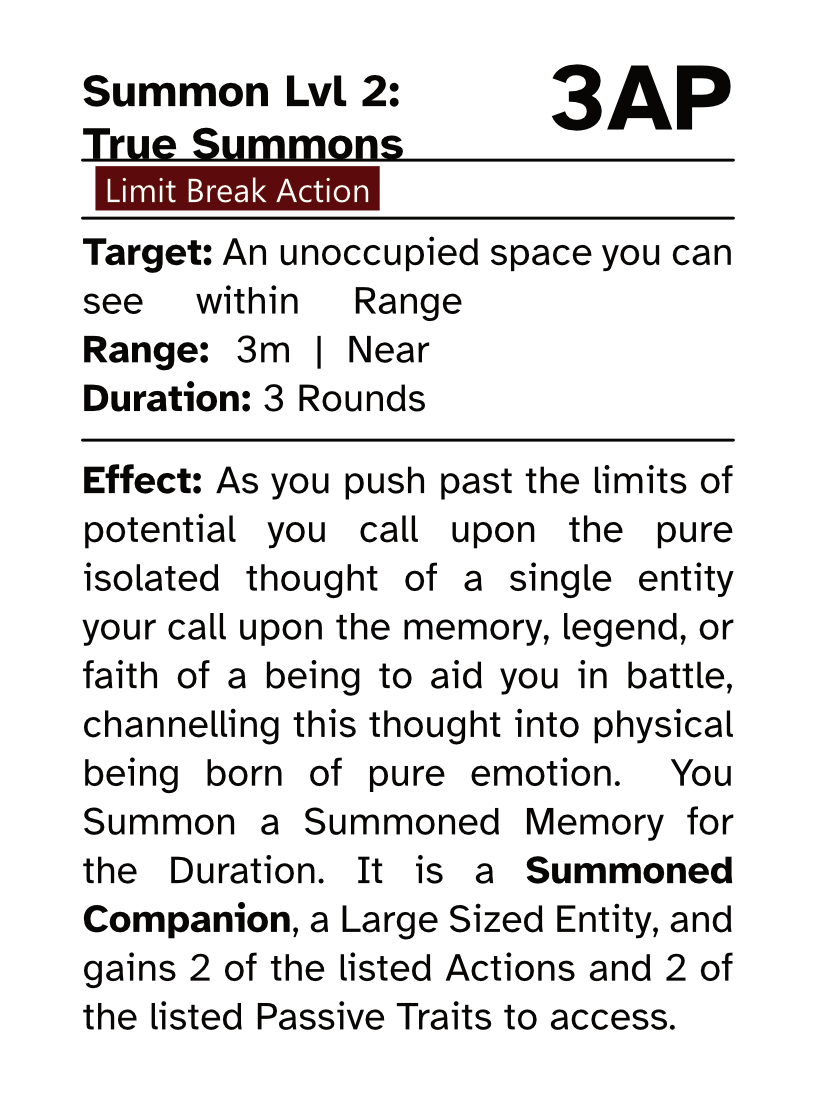
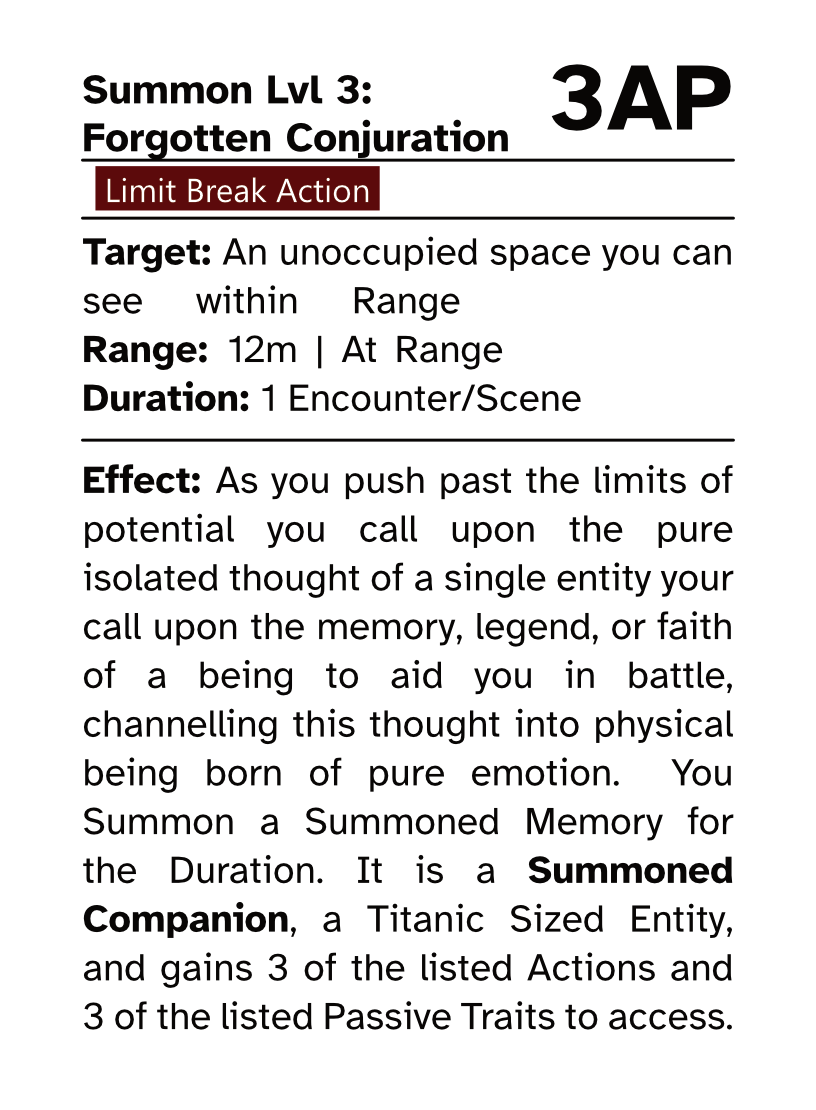
As Characters progress through their adventures, they may be able to summon specific entities using the Summoning Limit Break Actions. See the Game Guide’s Companion for details on making these entities.
When fighting underwater the following rules apply in addition to the normal rules for Underwater Environments:
In the Theatre of the Mind everything is held in the imagination of the GG and players. It can be rather difficult however to view spatially the layout of the combat especially with the exact Ranges of many Weapons and spells/powers. As such instead for Theatre of the Mind games it is recommended using the following layout for describing the scene:
All spells, powers, and ranged Weapons in this document will have both a metre Range Combat on a Map as well as a narrative range for Theatre of the Mind.
This game and its combats can be played out using a square or hex grid and miniatures or other tokens, to do so follow these rules:
Grid Distances. Each square or hex on the grid represents 1m. When moving to an adjacent square/hex it costs 1m of movement per square/hex, when moving diagonally on a square grid it costs 1.5m per square. To enter a square/hex, you must have at least 1 square/hex of movement left. If a square/hex costs extra movement, as a square of Difficult Terrain does, you must have enough movement left to pay for entering it.
Terrain Spaces. Movement can’t cross the corner of a wall, large tree, or other terrain feature that fills its space. On a square grid, this also prevents diagonal movement where the corner of the terrain are across is against the edge of the two spaces you wish to move between.
Gridless Maps. If you choose to play on a map without a grid, you can choose to use rulers or tape measures. If you choose this method, choose to use either inches or cm for your games.