




Whenever a Character comes across an obstacle in their path, the GG will ask for a Trait Test. If a Trait Test has not been asked for, then any dice rolls will not be counted. See our Game Guide's Companion for when and how to use Trait Tests.
The GG will ask for a specific Character Trait for a Test, such as asking for an Endurance Test. A Trait Test is calculated by rolling a d20 and adding the associated Character Trait value, there may be additional Bonuses/Penalties granted to this roll, at which point add those Bonuses/Penalties and then check the Total Test Value (TTV) vs the Test Goal (TG). If the TTV is equal to or greater than the TG, the test is considered successful.
Total Test Value (TTV) = d20 roll + Character Trait value + Additional Bonuses/Penalties
If you roll a 1 on the d20 for any Trait Test, no matter the TTV, it is a failed Test, known as a Critical Failure. However, when you score a Critical Failure, you gain a Mark of Fate to assist you in your future endeavours as you learn from the failure. For more details on Marks of Fate, see the Marks of Fate section of this Chapter.
If you roll a 20 on the d20 for any Trait Test, no matter the TTV, it is a successful Test, known as an Inspired Event. When an Inspired Event occurs, you gain the Inspired condition, for more information see the Inspired Actions Section of this Chapter. If an Inspired Event occurs due to an Attack Roll, then the result is also considered a Critical Hit, for more information see the Attacking Section of the Active Time Chapter.
If an ability states that it increases the Inspired Event Scope by a number, then that means the result of the d20 roll between 20 and 20 - the given number counts as an Inspired Event, and the opposite if an ability decreases the Inspired Event Scope (though a 20 on the d20 always counts no matter how much the Scope is decreased by). If multiple effects would increase and decrease the Scope, the are cumulative effects. So increasing the Inspired Event Scope by 2, means a d20 roll of an 18, 19, or 20 on a Trait Test count as an Inspired Event Scope, though if then a spell decreased the Scope by 1, for the Duration of the spell only a d20 roll of a 19 or 20 would count.
The same rules above apply to the Critical Failure Scope, though increasing the Scope instead means any d20 results between 1 and 1 + the given number count as a Critical Failure and the opposite an ability decreases the Critical Failure Scope (though a 1 on the d20 always counts no matter how much the Scope is decreased by).
Some abilities may increase the Inspired Event Scope, whilst others affect only the Critical Hit Scope. First calculate the Inspired Event Scope then expand that Scope by the Critical Hit Scope, though d20 results in this range do not automatically count as a Critical Hit (so the Attack Roll is successful and deal the additional damage) but not an Inspired Event for other kinds of Trait Test. For example, if an ability expended your Inspired Event Scope by 1 and another expanded your Critical Hit Scope by 2. Then a d20 roll of 17, 18, 19, or 20 are Critical Hits, but only a 19 and 20 are an Inspired Event.
If you fail a Trait Test you can choose to Push Through the challenge. Doing so gives you one Degree of Exhaustion condition, or with the GG's consent can instead grant you Disadvantage on the roll but harsher narrative penalties for failing the Test, and you can reroll the d20 but must use the new result.
You can only Push Through once per Trait Test made. If any other effects would Trigger from failing a Trait Test or the result of the original d20 roll, they are ignored unless you repeat the result with the rerolled d20.
Some Trait Tests may offer a Table of results based on what the TTV if the Test was compared to the spread of TGs. In this instance a failed Test is not achieving the minimum TG listed.
However, for abilities which Trigger on failing a Trait Test, they may Trigger if the result is anything other than the highest Degree of Success.
In the event of an Inspired Event, you are treated as having rolled one Degree of Success higher than the TG you met, if there is a higher Degree. Meanwhile with a Critical Failure, you automatically fail and do not refer to the Degrees of Success Table, unless their is a result for a TG of 0 or 1 at which point you use that result.
An entity may at any point choose to willingly fail a Trait Test. For the purposes of this rule an entity is only considered willing whilst the following is true:
You may ignore the above rules if the action performed whilst under the listed effects, would have been performed by the entity normally without any external or supernatural influence.
There will be times when an ability will say you have Advantage or Disadvantage on a Trait Test or the GG decides, for a number of factors a temporary event occurs that may make it easier or harder to perform a task, that you either have Advantage or Disadvantage for that Trait Test.
When this occurs, you will need to roll 2d20 when making the roll instead of 1d20. If you have Advantage, you use the result of whichever d20 had the highest result for calculating your TTV. If you have Disadvantage, you instead use the result of whichever d20 had the lowest result for calculating your TTV.
If when making the Trait Test multiple sources give you Advantage or Disadvantage on that roll you still only roll one additional d20.
If when making the Trait Test you have a single source of Advantage and a single source of Disadvantage, then they will cancel each other out. However if you have multiple sources providing Advantage or Disadvantage, then you count the number of sources of Advantage and Disadvantage comparing the result. If the number of sources for both are equal, they still cancel each other out. If one of the two effects has more sources than the other, that effect is applied to the Trait Test.
If you have Advantage or Disadvantage and the ability to reroll the d20, you can reroll one of the two d20s after they have been rolled but before selecting which is the highest/lowest to resolve the Advantage/Disadvantage.
A Party Challenge is a slightly different form of Trait Test. This is for times where the Party has to work together as a team to overcome a challenge. For example, escaping a collapsing tomb, chasing a thief over rooftops, or performing a magical ritual to bring back the dead. A Challenge works as follows:
The GG chooses the TG for each Trait Test and can choose in some cases for high rolls to count as multiple Successes.
A GG could choose to have multiple Scenes for a larger Party Challenge, where when the party succeeds or fails the current Scene's Challenge, they are moved to the next Scene. With each sequential Party Challenge following on from the last. Meaning the series of Party Challenges can work as one larger scale Party Challenge for a bigger effect.
Otherwise, the GG will move on from the Challenge based on the consequences of the Party Challenge's success or failure.
GGs should look to the Game Guide's Companion for further guidance and advice for the use of this tool.
Sometimes instead of a challenge that can be best represented by a normal Trait Test with a set TG, you may attempt an action that put your own skill and will against another's, this is known as a Contested Test.
When this occurs you will perform the Trait Test as normal but the entity you are affecting will also make their own Trait Test. Whoever is committing the action that leads to the Contested Test, will treat the TTV of their opponent's Trait Test as the TG of their own Trait Test.
There are six Character Traits available for any Character.
Physique. This represents the physical prowess of your Character. You would take a Physique Test to swing a Weapon or lift a weight.
Agility. This represents the nimbleness of your Character alongside their hand-eye-coordination. You would take an Agility Test to perform some acrobatics or to throw a dart.
Endurance. This represents how far your Character can push their body before reaching its limit. You would take an Endurance Test to keep running during a marathon or to resist a poison.
Knowledge. This represents what your Character knows. You would take a Knowledge Test to recall something you have learnt or to be able to piece together facts and knowledge to help discover some unknown truths.
Intuition. This represents the ability of your Character to draw on their experience and apply those lessons learnt to the present. You would take an Intuition Test to be able to help track target through the woods or to notice something in the distance.
Determination. This represents your Character's ability to call upon their confidence and ability to interact with the world around them. You would take a Determination Test to be able to interact with other entities or to place your will into the world.
A Character Trait can never go below a -2 and never go above a 5.
Traits are not generally viewed as some supernatural representation of anything, it represents your Character's training in a particular aspect of your Character. With an average person who hasn't spent time training in a Trait being at 0. When you choose your Traits during character generation, this shows where your Character focused their training in their Background and that they will spend some of their free time training to maintain that Trait's value.
But during play, your Character may choose to focus on training themself in something else. Whenever you hit a Narrative Milestone, or your Character increases their Character Level, you can choose to reduce one Trait value by any amount to then increase a second Trait by the same amount, within the Trait value limits stated above. A GG can choose to allow this during Downtime or during a series of Long Rests (though for Long Rests we advise a Trait's value can be decreased/increased by no more than 1 per Long Rest) based on the type of Campaign you are playing in.
This change can happen at other times if you find, especially at the start of a Campaign, your Character's Traits do not quite match where the Character is after you have had a chance to play them. Speak with your GG and if you both agree, feel free to swap around Trait values between Character Traits to better represent what the Character is like to play.
Skills are the most common kind of Bonus that can be applied to a Trait Test. They can only be applied if the Skill is applicable with the specific action the Trait Test is being used to determine the success of. While Skills are no tied to any specific Character Traits, there are some recommended combinations for GGs to refer to for ease of game running. The Skills we use as part of the Core Rules are:
| Acrobatics | This skill is for trying to perform an acrobatic feat such as rolling, tumbling out of the way of an attack, balancing, or breaking a fall. We recommend the Agility Trait. |
| Animal Handling | This skill is for trying to interact with animals or maintain control of an animal Mount. We recommend the Intuition Trait. |
| Athletics | This skill is for trying to perform a physically taxing ability, like running a marathon, jumping, swimming, lifting an object or resisting being pushed by another. We recommend the Physique Trait. |
| Cosmology | This skill is for trying to recall knowledge about the metaphysical workings of creation. We recommend the Knowledge Trait. |
| Deception | This skill is for trying to lie to another entity. We recommend the Determination Trait. |
| Diplomacy | This skill is for trying to convince an entity to agree with your point of view. We recommend the Determination Trait. |
| Driving | This skill is for trying to steer a vehicle. We recommend the Physique or Agility Traits depending on the nature of the vehicle. |
| Empathy | This skill is for trying to get a read on another entity you are interacting with. We recommend the Intuition Trait. |
| Faiths | This skill is for trying to recall knowledge about religions, deities, and other supernatural entities that faiths, cults, and similar institutions may interact with. We recommend the Knowledge Trait. |
| Focus | This skill is for trying to resist certain effects either through willpower or self-discipline or identifying weaknesses in an attacking spell. We recommend the Knowledge, Intuition, and Determination Traits depending on what is having to be focused on. |
| General Knowledge | This skill is for trying to recall knowledge of cultures, peoples, places, politics, and past events. We recommend the Knowledge Traits. |
| Intimidation | This skill is for trying to use your physical presence or threats to convince someone to your point of view. We recommend the Physique or Determination Traits. |
| Investigation | This skill is for trying to find clues to help gather information from an area. We recommend the Knowledge or Intuition Trait. |
| Linguistics | This skill is for trying to recall and understand languages you are not fluent in. We recommend the Knowledge or Intuition Trait. |
| Magical Lore | This skill is for trying to recall knowledge about magic and magical creatures. We recommend the Knowledge Trait. |
| Medicine | This skill is for trying to perform actions to help identify injuries and Diseases, recall knowledge of anatomy, and potentially treat injuries or Diseases. We recommend the Knowledge or Intuition Trait. |
| Nature | This skill is for trying to recall knowledge about animals, plants, world souls, and things tied to the natural world. We recommend the Knowledge Trait. |
| Perception | This skill is for trying to notice details in the world around you using your senses. We recommend the Intuition Trait. |
| Performance | This skill is for trying to create a piece of art, perform some music, dance, or perform a similar creative pursuit. We recommend the Determination Trait. |
| Skulduggery | This skill is for trying to pick a lock, pickpocket, or commit a similar action that requires fast hands without being noticed. We recommend the Agility Trait. |
| Stamina | This skill is for trying to maintain a physical activity for a period, resisting environmental conditions, or resist Poisons, Venoms, or other foul substances. We recommend the Endurance Trait. |
| Stealth | This skill is for trying to Hide from others. We recommend the Agility Trait. |
| Survival | This skill is for trying to follow tracks, forage, or commit similar actions needed to survive in the wild or travel. We recommend the Intuition Trait. |
| Technology | This skill is for trying to operate or recall details of technological or technomagical devices. We recommend the Knowledge Trait. |
If a Character has Learnt a Skill, then that Skill will confer a Bonus called a Skill Bonus (SB) to Trait Tests where the Character can reasonably use that Skill to overcome the obstacle. As a Character increases their Character Level, their Skill Bonus naturally increases at set Levels as shown in the table below.
A Character can Master a Skill with sufficient training, if a Character is a Master in a Skill, they can double their Skill Bonus when used for a Trait Test.
| Character Level | Skill Bonus |
|---|---|
| 0 | +1 |
| 1-4 | +2 |
| 5-8 | +3 |
| 9-12 | +4 |
| 13-16 | +5 |
| 17-20 | +6 |
You may see notation of Skill Name:Specific Aspect such as Medicine:Forensics or Perception:Sight, that specific aspect in relation the the core Skill is known as a Skill Focus. If you make a Trait Test that uses that Skill and that is related to the Focus, you gain Advantage on the Trait Test.
So, if you have a Skill Focus of Perception:Sight, then whenever you make a Trait Test where you are using the Perception Skill and it can make use of your sight then you have Advantage on that Test.
There may be a time where the GG wants to specifically call upon one Skill as it is the only one effective to proceed through a task. In this instance it is called a Skill Roll.
A Skill Roll follows all the normal rules of a Trait Test, the GG will call for a Trait of their choosing (Players should feel free to suggest Traits and how they would use them) then make that roll using the specific Skill and the appropriate Skill Bonus, based on to what Degree the Character had Learnt the Skill. This will be presented as Trait (Skill Name) in this text.
A variant of the Skill Roll is a Passive Skill Value, this may be requested by the GG, to get a sense of how good each Character is at a Skill. For this they will call upon a Trait as done with regular Skills Rolls, but instead of rolling a d20 you calculate the result as if you had rolled an 8, adding +/-5 to the result if you would have Advantage or Disadvantage respectively.
In addition to the Character Skills your Character will start the game with after character generation, your Character can Learn additional Skills during play. A Character can choose to Learn new Skills during Downtime, for more details please see the Downtime Chapter.
They can also Learn them during extended time periods during play such as in the Travelling Phase (See see the Travel Section of the Exploration & Travel Chapter), if the travelling will take multiple days. The Character would require materials to learn from and sufficient time to focus, we would advise at least 3 Hours during a Day. If this happens, during the next sleep period the Character can make an appropriate Trait Test for the chosen Skill. The TG equals 15 - the number of Hours spent studying that Day.
On a failed Test, the Character does not progress their learning, but they can add half the number of Hours they spent that Day studying, to the Hours spent studying the next time they take a Trait Test to Learn that Skill.
On a successful Test, roll a d100 noting down the result as Study Progress for that Skill. If you already have some Study Progress for that Skill, instead add the d100 result to that Skill's Study Progress. Once the Study Progress for any Skill is over 100 then the Character has Learnt that Skill and can gain the benefits of the Skill Bonus for Trait Tests.
While learning on the road as stated above, the Character can only Learn a Skill. To become a Master in a Skill, you must spend time mastering a Skill during Downtime or gain Mastery from alternate means such as from your Class Features or from being taught by another Character that has Mastered the Skill already. For gaining Mastery with a Skill the total Study Progress, starting from 0 after having Learnt the Skill, must surpass 200 rather than 100.
Any Character can choose to teach another Character a Skill the teacher knows. When this happens for the rules for Learning a Skill (see above), however the Character doubles the time taken for the teaching when determining the Trait Test's TG. The teacher also makes the same Trait Test as the student adding the result of that Test as additional Study Progress for the student.
If the teaching Character is a Master of that Skill, and the student Character has Learnt the Skill, then you can use the Learning a Skill rules for Learning to Master a Skill. The only difference is that the teacher does not make a Trait Test to add any result to their student's Study Progress.
While too many Skills can lead to Character Sheet bloat making it hard to parse information on the Character Sheet and leading to some Skills having not much use due to aspects it should include being covered by other Skills. If as a GG your setting, narrative, or table's choices lead to something that should be included as a Character Skill that is not presented in the above Skill list as an option for your Character to take.
Characters often take part in heroic adventures and may find in their times of need fate is on their side, turning a disaster into something salvageable. You can only have one Mark of Fate at any one time, if you would be given a Mark of Fate while already having the maximum amount you can have at once, you can grant it to another Character. A Mark of Fate disappears at the end of the Character's next Long Rest.
If you gain a Mark of Fate, you can expend it at any time for one of the following benefits:
Some extra choices are provided by Classes as well as potentially Items, Feats, and other sources.
If you expend a Mark of Fate for one of its benefits, the GG gains a Mark of Fate. A GG can never have more Marks of Fate than the Character Level of the Party or the number of Players at the Table whichever is greater. A GG starts each Session with a Mark of Fate, and they all disappear at the end of the Session except where a Scene has only be paused and will be resumed at the next Session, at which point after that Scene the Marks of Fate are lost as if the Session ended there.
A Player currently involved in a Scene, may also offer a Mark of Fate to the GG to affect something about the nature of the world, maybe offering it to incite a complication in a Scene their Character is present in or to add detail to the environment. The GG and wider Table can decide if it is accepted, if it makes sense for the Scene, and if it is a fun idea that adds to the moment. If the GG and Table accepts, the GG takes your Mark of Fate and adds it to their pool, narrating the change to the current Scene.
While a GG has a Mark of Fate, they can use the Mark to gain a benefits listed above to an NPC, to Curse a Character granting them Disadvantage on their current Trait Test, or to offer a bargain to a Player (See Concepts Section for more details). After a Mark of Fate has been used by the GG any of these ways, the GG can give the Mark of Fate to a Character that can currently accept one.
When you have the Inspired condition, such as from having rolled an Inspired Event, you gain the ability to expend the condition to perform an Inspired Action. This action can be performed at any time you could normally perform an action and costs 1 Action Point.
We have split for ease of use some Inspired Actions for general use, socialising, exploration/travel, and in combat. That does not mean with some creativity they could not be used outside of their assigned space, this is just for quick referencing.


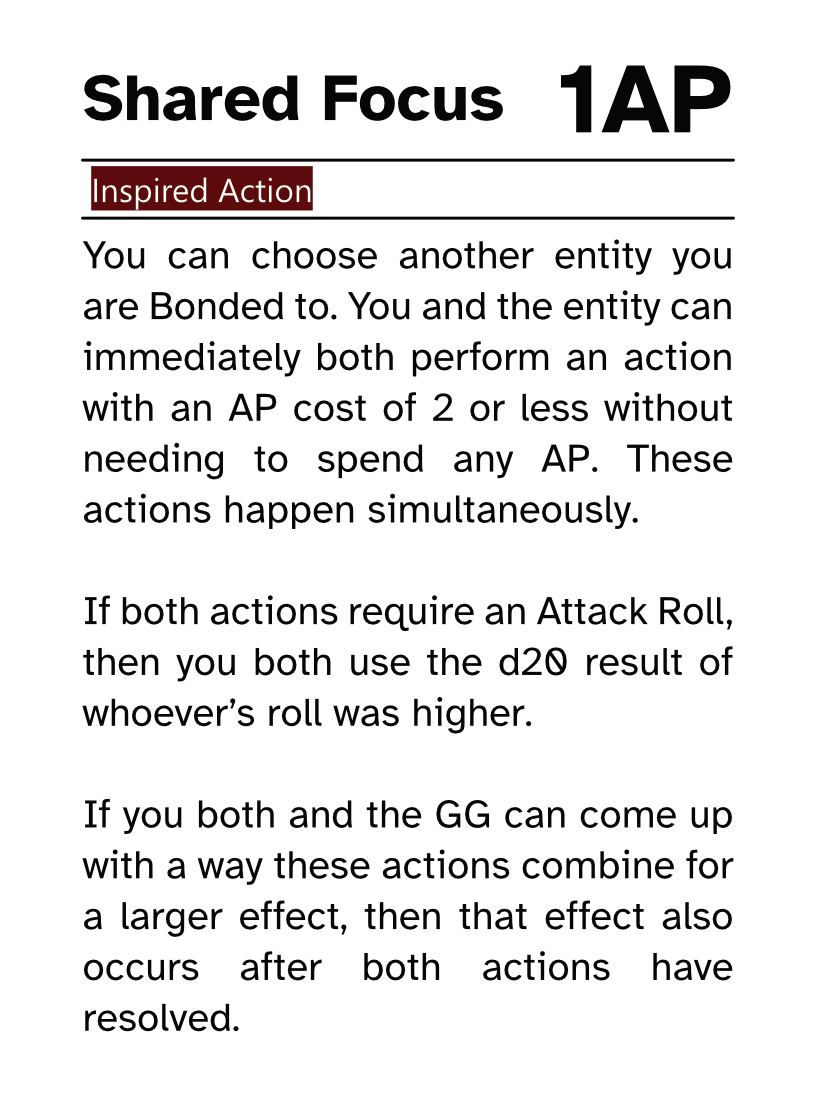
Every Class and certain Magic Items, or other sources may grant additional Inspired Actions to those listed here.
A Player may also have a very cool and creative idea in the moment of an action that is not normally covered by the rules. If so, they should discuss with the GG if they can perform said idea as an Improvised Inspired Action. This still requires the Inspired condition and 1 Action Point to perform, but can be used for memorable and standout moments at your Table.
Concepts are abstracted sentences that describe an aspect of your Character. Different areas of Character generation will go into more details about each Concept and how they are formed.
When an entity, including you, makes a dice roll, you or another can Invoke a Concept. You must have an ability that allows you to do so such as by expending a Mark of Fate. Whoever is Invoking the Concept must explain why it is relevant to the roll. If the GG accepts the premise, then one of the following effects occur:
The GG may choose to Invoke one of your Concepts for one of the above listed effects to affect an NPC or your Character, or they can cause your Character to alter their current roleplay based around the Invoked Concept, though note if a GG Invokes a Concept for one of the above listed effects, if appropriate, your Character's behaviours should, after the effects of the dice roll has been resolved, act more according to the Invoked Concept over other behaviours. A bargain can be made where you offer to roleplay in a scene according to one of your Concepts or the GG can offer you to play according to the specific Concept, if this is agreed upon once the affected Scene has concluded you gain a Mark of Fate, so long as you are not at your maximum number of Marks of Fate.
Multiple Players may each Invoke a single Concept to affect one roll (for this effect the rule for only one instance of a type of Bonus/Penalty being counted for affecting a roll is ignored), but a Player can only Invoke one Concept per roll. The GG likewise can only Invoke one Concept per roll.
As a Character grows on their journey, they may feel a better Concept exists to reflect where they are now. This can be done every time the Character Levels up, or as part of a larger Character change, such as changing Classes or other special events that may occur in play. Speak with your GG about this if you wish to make such a change outside of Levelling.
Sometimes a Character may interact with the wrong Magical Item, make a deal with a Masked Evil, or experience something worse, when this occurs a new Temporary Concept may be applied, often including a personality shift tied to an external source, that for as long as it lasts replaces another Concept on the Character's Sheet, this replaced Concept becomes known as a Forgotten Concept.
At a point when a Character would be able to change Concepts, they can choose to either embrace the change making it a permanent change to their Character, and consequently removing their Forgotten Concept. The Character can choose to instead keep the Temporary Concept temporary and see where the story takes the Character, potentially removing the Temporary Concept or embracing it.
The GG may also choose to for one reason or another, potentially tied to an Item or change in the Character add an additional Concept, this is treated as a Temporary Concept but instead of replacing a Concept being an additional one, often tied to the existence of the source of the Concept and its connection to the Character, though in all other ways works as a Temporary Concept normally would.
Time can generally be run in two kinds of time progression, Narrative Time and Active Time.
Narrative Time where most of the game takes place, this is a lot vaguer and actions happen in no specific order, Seconds or Days can pass in a moment depending on what is occurring. In this time progression keeping track of Action Points or similar mechanics working with a Character's Turn do not matter and can occur freely so long as they make sense in the Scene.
Active Time is where Characters operate on a specific Initiative order, time will flow in Rounds and Turns, and each Character will have a set number of actions that can be performed per Turn, etc. Rules for Active Time Encounters will be covered in the Active Time Chapter.
Some mechanics will have avariety of time measurements mentioned, they are treated as follows:
A Short Rest usually lasts for only an Hour. To call a Short Rest the Party must make a Campfire, traditionally this will require some firewood and a tinderbox/matches, but there are other ways that the Party may find on their travels.
During a Short Rest, each Character can perform one Activity, Activities may be specific abilities granted by a Character's Class, Ancestry, or others means that can only be performed during a Short Rest.
A general Activity any Character can perform is preparing a Meal or other refreshment like a pot of tea, this will require a Trait Test, the exact Trait can be discussed between the Player and the GG.
A TG of 10 or more will produce a Meal that, if consumed, will allow a Character to replenish their HP by expending any number of their Hit Dice, rolling the expended dice, and regaining HP based on the calculation below.
HP Restored = The sum of the results of the rolled Hit Dice + (the Character's Endurance x the number of Hit Dice expended)
A TG of 20 or more, will allow a Character that consumes the Meal to also reduce the severity of one Moderate Scar Concept to a Mild Scar Concept.
If the Meal uses nothing more than Basic Rations, any TTV greater than a 10 is treated as a 10.
If during the Meal your Party shares a moment to talk and socialise, at the end of the Scene, each Character that took part gains a number of Barrier Points equal to twice their SB.
Things Characters can do that are not counted as Activities are forming a Soulbond with a Magic Item, eating, drinking, and socialising.
At the end of the Short Rest, some Features or other effects the Character has may state their are affected or replenished at the end of a Short Rest, and are affected/replenished as stated in the Feature's/effect's description.
Characters usually will need to sleep eventually. For this a Character can choose to take a Long Rest. There is no time specific requirement of when a Long Rest can be called, with the only requirement being that a Character must have not benefited from the effects of a Long Rest within the last Day. To call a Long Rest unless you are in are in a resting location such as an Inn or a Hostel, you must assemble a Campfire just like a Short Rest.
A Long Rest on average takes 8 Hours or for Worlds with different lengths of time a third of the number of Hours of the Day. During this Rest, a Character can perform two Activities, as part of 2 Hours of the Rest. The rest of the Rest the Character needs to sleep. Once the time for the Rest has passed, so long as they have consumed at least 20 Units of Food & Drink since their last Long Rest, the Character gains the following benefits:
If the Party has their Rest interrupted, then if the interruption was under 2 Hours the Party can act as if their Rest wasn’t interrupted. If the interruption took more than 2 Hours, then the Party is immediately considered to have taken a Short Rest and must spend a number of extra Hours equal to the interruption to gain the benefits of a Long Rest. An interruption is anything more strenuous than but also including physical exertion such as constant walking or combat.
Unless a Character is wearing Armour Pieces that have the Comfortable Armour Property, they cannot gain the benefits of Long Rest if they try to sleep whilst wearing the Armour Pieces.