




The School of the Ancestral Warrior focuses on training its warriors to focus on connecting with their weapon, earning about their history and drawing forth the knowledge and skill of its past wielders.
Called Ghost Warriors, many warriors from this school can be found delving into ancient ruins, scouring lost archives, or travelling to sites of momentous historical events. Others may be found in noble families who have long catalogued every detail of their bloodline, forcing the incumbent warrior into endless study to uphold their bloodline’s potential.
The most famous of this school however, hunt down legendary beasts whose souls are strong enough and formidable enough to activate the latent soul power left within their blades.
1st Tier Ghost Warrior Feature
You have been trained in a variety of skills to aid you in learning of and attuning to your Weapon. Choose any two Skills to Learn, then choose one Skill you have Learnt to Master.
You can perform the Study action for 1AP, and you also gain an additional Fighting Style Feat.
When using the Study action in an area with appropriate records of information, such as the local archives or a library. You are always treated as being a Master in the Skill to research your Ancestral Weapon, legendary entities, and folklore, if you already were a Master in that Skill, you gain a +3 Divination Bonus to the Test.
1st Tier Ghost Warrior Feature
You have trained to remain mobile using techniques passed down through generations. You can perform the Dash and Disengage Combat Step Actions and the Disengage action for 1AP.
The AP cost increase for multiple uses of the Movement action and Dash Combat Step Action on a Turn, increases by 1AP rather than 2AP.
1st Tier Ghost Warrior Feature
You have found an ancestral weapon, used by countless generations of masters of this weapon, now in your hand a spark of its forgotten power has awakened. Choose a non-magical Weapon to be your Ancestral Weapon, you immediately form a Soulbond with the Weapon, and it does not count against the number of Soulbonds you can maintain at once. You Ancestral Weapon gains the following benefits:
Awakened Blade. This Weapon becomes Awakened, it becomes magical, gaining a Magic Bonus to Attack and Damage Rolls equal to your Tiers in this School, and gains Awakened Tier 1, with it gaining two Concepts instead of the normal one; “Ancestral Blade” and another Concept that is the Weapon’s name.
If a part of the Campaign, this Weapon also gains the 1st Weapon Level.
Mastercrafted Weapon. This Weapon becomes Mastercrated.
When you would form a Soulbond with another Weapon with either Enchantments, Gemstones, or Runes, you may once the Soulbonding rite has concluded choose to instead of forming a Soulbond choose to absorb either the Enchantments, Gemstones, or Runes from the Weapon and apply them to you Ancestral Weapon.
If you do so the Ancestral Weapon loses any of the chosen enhancements they currently have as they are replaced with the newly acquired ones, meanwhile the other Weapon will loose those enhancements that have been taken from it.
Mirror Blade. When you Draw this Weapon if it does not have the Two-Handed Weapon Property and your other hand is free, you can summon a spectral copy of the Weapon into your off-hand which, so long as the Weapon does not have the Heavy Weapon Property, gains the Light Weapon Property.
While wielding both your spectral mirror blade and your Ancestral Weapon, you gain access to the Fuse Weapon action.
Strength From Souls. After reducing an entity, other than one with a Minion Entity Tag, to 0 HP during a Critical Engagement this Weapon gains power from the foe. You replenish a number of expended Combat Step Die equal to the CR of the slain entity.
Suited to the Wielder. Your Ancestral Weapon is always considered one of your Active Weapon Focuses, and your Inspired Event Scope with this Weapon increases by 1.

2nd Tier Ghost Warrior Feature
You have learnt to commune with the spirits of your Ancestral Weapon’s past wielders. When you gain this Feature, speak with your GG to begin discussing what kind of past wielders of your Ancestral Weapon may have had, and what kind of knowledge you may be able to glean from them. Though your Character may not know this information, and only glean it after performing the appropriate in game research.
As an Activity during a Rest, you can attempt to commune with the lingering spirits of your Ancestral Weapon’s past wielders.
You may ask them a number of questions up to half your Skill Bonus. These questions must be ones that can be answered with a yes or no, unless your GG says otherwise, though if the GG believes a one-word answer could be misleading or contrary to their interests a short phrase may be given as an answer instead.
You receive a correct answer for each question, based on the faded knowledge, memories, and viewpoints of these lingering souls. They aren't omniscient, so you might receive "unclear" as an answer if a question pertains to information that lies beyond their faded knowledge.
When you complete a Long Rest, you may choose a number of Combat Step actions up to half your SB, which you know until you next complete a Long Rest, as the spirits tied to your Weapon teach you their techniques in your dreams. These Combat Step Actions can be from any Warrior School, though if you do choose Step Actions from outside a School you know, all the Combat Step Actions chosen have to be from that School or General Steps.
In addition, your Ancestral Weapon becomes Awakened Tier 2, and if a part of the Campaign, this Weapon also gains the 2nd Weapon Level.
The Ancestral Weapon’s Strength From Souls ability, now allows you when the conditions are met instead of replenishing Combat Step Die, lets you replenish a number of expended Hit Die equal to the CR of the slain entity.
As noted in the Art of Combat Feature, certain masters can teach a Warrior Legendary Combat Step Actions. A GG can choose for narrative rewards or progression for a Warrior of this School, who has unlocked the ability to commune with the spirits of past wielders, could learn unique Legendary Combat Step Actions from them. Methods maybe that would inspire the spirit to seek to teach the Warrior could be performing actions that align to the values and ideals of a specific spirit, or besting a particularly dangerous foe.
Maybe for a number of Long Rests the Character has to pick this one Legendary Combat Step action which starts off weaker, but as it is used more and more it grows to its full potential until finally the Warrior can add it to their repertoire.
3rd Tier Ghost Warrior Feature
You have learnt how to make the best use of your actions to always keep momentum in a fight. You gain the following benefits:
You gain an additional Combat Step Die.
You increase the number of Combat Step Actions you know by 1.
After moving at least half your Movement speed, or after hitting a Target with an Attack Roll made with your Ancestral Weapon, the next Attack Roll you make with your Ancestral Weapon this Turn, is made with Advantage.
For Attack Rolls made using your Ancestral Weapon, if they miss you can perform the Set-Up Combat Step Action for 0AP, when used this way it’s AP is not increased for multiple uses in the same Turn.
When you score a Critical Hit using your Ancestral Weapon, recover one expended Combat Step Die.
In addition, your Ancestral Weapon becomes Awakened Tier 3, and if a part of the Campaign, this Weapon also gains the 3rd Weapon Level.
The Ancestral Weapon’s Strength From Souls ability, now allows you when the conditions are met instead of one of the other options, lets you increase the your Critical Hit Scope of the next attack made with this Weapon, by half the CR of the slain entity.
4th Tier Ghost Warrior Feature
You have learnt how to tap into your weapon’s soul of battle. When fighting in a Critical Engagement, each time you deal damage to a Target without the Minion Entity Tag, this Weapon increases its Soul Bonus to Damage Rolls by 1 (starting at +0), this Bonus disappears at the end of the Encounter/Scene.
You also gain a Speed Bonus to your Attack Rolls with your Ancestral Weapon, equal to half your Soul Bonus (rounded down).
Your Ancestral Weapon gains the following benefits:
You gain an additional Combat Step Die.
You increase the number of Combat Step Actions you know by 1.
After moving at least half your Movement speed, or after hitting a Target with an Attack Roll made with your Ancestral Weapon, the next Attack Roll you make with your Ancestral Weapon this Turn, is made with Advantage.
For Attack Rolls made using your Ancestral Weapon, if they miss you can perform the Set-Up Combat Step Action for 0AP, when used this way it’s AP is not increased for multiple uses in the same Turn.
When you score a Critical Hit using your Ancestral Weapon, recover one expended Combat Step Die.
In addition, your Ancestral Weapon, if a part of the Campaign, this Weapon also gains the 4th Weapon Level.
The Ancestral Weapon’s Strength From Souls ability, now allows you to split the CR between the different effects that can occur.


The School of the Blade Dancer focuses on training its warriors to focus on their own performance in combat. These warriors are masters of the flow of combat, gracefully moving from one step to the next with ease. Knowledgeable of many styles of combat form and stances.
Called blade dancers, warriors who train in the school are found both in the midst of the battlefield, but also as cunning duellists and travelling warriors for hire. The most experienced of their number potentially being invited to the homes of noble families as either a bodyguard or as tutors for their children.
1st Tier Blade Dancer Feature
You have been trained in skills useful for both developing your tactics and leadership abilities. Choose any two Skills to Learn, then choose one Skill you have Learnt to Master.
You also gain an additional Fighting Style Feat.
1st Tier Blade Dancer Feature
You are experienced in the art of combat. You gain the following benefits:
Your Inspired Event Scope increases by 1.
When you score an Inspired Event, you can move up to half your Movement speed. This Movement does not provoke Opportunity Attacks.
You gain an additional Combat Step Die.
You increase the number of Combat Step Actions you know by 2.
You have Advantage on Initiative Tests.
Your Weapon Attacks and Unarmed Strikes deal an additional 1d4 damage of the Weapon/Unarmed Strike’s Damage Type.
2nd Tier Blade Dancer Feature
Fate warps to match the steps of your dance. Your Blade Dancer Feature’s additional damage’s damage die increases its size to 1d6. Once per Turn, if you would make a Trait Test to resist or avoid a harmful effect, you can choose to roll the additional damage’s damage die from the Blade Dancer Feature and add the result to your Test’s TTV.
If you do so, you do not gain this additional damage die for Damage Rolls until the end of your next Turn.
You gain the Warp Fate action.

You may use this action a number of times up to your Skill Bonus, replenishing expended uses upon completing a Long Rest.
3rd Tier Blade Dancer Feature
You know how to exploit the weaknesses of your foes. You gain the following benefits:
Your Inspired Event Scope increases by 1.
You gain an additional Combat Step Die.
You increase the number of Combat Step Actions you know by 1.
If a Compulsory or General Combat Step Action would cost more than 3AP, its AP cost is reduced for you to 3AP.
In addition, your Blade Dancer Feature’s additional damage’s damage die increases its size to 1d8.
4th Tier Blade Dancer Feature
You are the embodiment of a martial fighter. At the start of each of your Turns, so long as you have the Bloodied condition but not the Dying condition, you regain HP equal to your SB + your Endurance Trait.
Your Weapon Attacks and Unarmed Strikes ignore Damage Reduction for Bludgeoning, Piercing, and Slashing damage.
If you score a Critical Hit with a Weapon Attack or Unarmed Strike, you also ignore Resistances to Bludgeoning, Piercing, and Slashing damage, and increase the Damage Roll result by your Warrior Level.
In addition, your Blade Dancer Feature’s additional damage’s damage die increases its size to 1d10.
The School of the Cataphract focuses on training its warriors to focus on mounted combat. These warriors are masters of battle on the back of an appropriate combat mount, able to perform incredible feats not just on the back of land-based mounts but even underwater or flying mounts.
Called cataphracts, warriors who train in the school are found on the battlefield, as a part of a cavalry charge. Though some also may be found in more ceremonial roles. Adventurers from this school, however, are more often lone wanderers travelling with their companion from place to place, helping those in need they come across. Especially as bandits and monsters are not prepared for an armoured warrior and steed charging towards them.
It is recommended for those who take up this school, to have taken the Fighting Style: Mounted Fighter Feat.
1st Tier Cataphract Feature
You have been trained in skills useful for working with a battle mount. Choose two Skills from Animal Handling, Empathy, General Knowledge, Magical Lore, Medicine, Nature, and Survival. You Learn the chosen Skills and then can choose one of the listed Skills you have Learnt to Master.
You also can Learn an additional Language of your choice.
1st Tier Cataphract Feature
Every cataphract needs a suitable companion. When you gain this Feature, you can choose any willing entity you have currently met that is capable of being you Mount to form a bond with; this target replaces its current Stat Block with the Cataphract’s Mount presented below, gaining the Entity Type of the bonded entity. This Cataphract’s Mount follows the rules presented in the Class Companions section and Mount section of the Other Rules Chapter of the Core Rules. If you have not met a suitable entity, you find a Horse to bond with.
The Mount is friendly to you and your allies and obeys your commands. Its game statistics are in the Cataphract’s Mount Stat Block presented below, which uses your Skill Bonus (SB) in several places.
In combat, the Mount shares your Turn in Initiative, and you can weave its actions amongst your own. When it is reduced to 0 HP, you may either use your Second Wind reaction to restore your Mount’s HP as if you had used the reaction on yourself, or it leaves the battlefield to recover, effectively counting as being Taken Out of the Fight. If you were Mounting it when this occurs, this counts as a Forced Dismount with you falling off the Mount. Once you have finished a Short or Long Rest, you can whistle and the Mount will return to you, if it can physically reach your current position.
You gain a Shared Bond Concept with your Cataphract’s Mount “Cataphract’s Mount”. A Bond Concept with your Cataphract’s Mount does not count against the number of Shared Bond Concepts you can have at any one time.
It may be the entity you form a bond with is unique, at which point with GG approval any special movement types, senses, abilities, actions, reactions, etc are applied to the Cataphract’s Mount Stat Block. Any Traits the entity had that are higher than those presented in the Mount’s Stat Block may use the higher values instead.
HT: 14 + SB
HP: 14 + SB + [5x Class Level]
Speed: 12m
Initiative: -
Hit Die: [Class Level]d10
| PHY | 4 | KNO | 1 | ||
|---|---|---|---|---|---|
| AGI | 3 | INT | 1 | SB | [Your SB] |
| END | 2 | DET | -1 |
Senses Passive Perception (11 + SB)
Languages Understands any Language the Warrior knows
Bonded Mount. You can add your SB to any Trait Test that the Mount makes.
Whenever you would restore your own HP, your Mount recovers the same amount of HP.
Any Warrior Features or Combat Step Actions/Reactions that affect you, also affects your Mount at no additional cost.
Cataphract’s Charge. Once per Turn, when this Mount takes the Movement action, you can expend a Combat Step Die and roll it. Increasing the Mounts Walking speed by a number of metres equal to the Step Die’s roll until the end of the Turn.
The Mount has 2AP and 1RP.
Forceful Bite, Claw, or Kick (2AP). Melee Natural Weapon Attack Roll: +(4 + SB). Target: 1, Reach: 1m/2m. Hit: 1d8 + 4 + SB Force damage.
1st Tier Cataphract Feature
You are experienced in the art of mounted combat. You have Advantage on Trait Tests made to avoid falling off your Mount.
If you fall off your Mount and descend no more than a number of metres equal to your Agility (minimum of 2), and you are not Incapacitated, you can land on your feet.
2nd Tier Cataphract Feature
Not every battlefield is on an open plane. Your Cataphract’s Mount can change its form, this may be magical or technological changes to allow your Mount this ability, or maybe you have bonded with multiple Mounts and your whistle calls to a different one for each form you need. At the end of a Long Rest, you can choose for your Mount to gain a Swim or Fly speed equal to its Walking speed. If the Mount gains a Swim speed it can also breathe underwater.
This change lasts until you next decide to change its chosen speed during a Long Rest.
In addition, your Opportunity Attack gains an additional Trigger, when an entity moves at least 1m within your AoC.
3rd Tier Cataphract Feature
The bond you share with your mount is so strong it allows for unique effects to occur. Once per Encounter/Scene, you may invoke your Bond Concept with your Mount selecting one of the options listed in the Relationships & Bonds section of the Socialising & Relationships Chapter of the Core Rules.
In addition, any beneficial spells or psionic powers that Target only you, also now Target your Mount so long as it is within 3m (Near) of you. Your Mount also gains the Multiattack Trait.
Multiattack. The Mount when it performs the Forceful Bite, Claw, or Kick action makes a number of separate attacks as part of the action equal to half your SB.
4th Tier Cataphract Feature
You have mastered the art of mounted combat. You gain +1RP. While Mounted, you treat your Size Category as being one Size Category larger than normal for the size of entities you can affect with your actions’ effects.
If you score a Critical Hit, your Mount can make an immediate Forceful Bite, Claw, or Kick attack, if this attack hits it automatically counts as a Critical Hit but not an Inspired Event.
In addition, your Mount’s Forceful Bite, Claw, or Kick action increases its damage die to 1d10, and you can expend a Combat Step Die to roll it and increase the Damage Roll of the Mount’s attack by the amount rolled.


The School of the Gunslinger focuses on training its warriors to focus on the use of new and experimental weapons known as firearms in combat. These warriors are masters of the creative uses of firearms, to deal with many different kinds of situations.
Called gunslingers, warriors who train in the school are rarely found on the battlefield, as this new technology has yet to be taken up by many traditionally minded leaders. Many gunslingers are instead found as wanderers, some performing for money, while others act as law bringers.
It is recommended for those who take up this school, to have taken the Fighting Style: Marksman Feat.
1st Tier Gunslinger Feature
You have learnt a variety of skills from your time travelling. Choose two Skills from Empathy, General Knowledge, Perception, Performance, Survival, and Technology. You Learn the chosen Skills and then can choose one of the listed Skills you have Learnt to Master.
You also gain Training in one Tool of your choice.
You may treat any Fighting Style Feat effects and actions that apply to melee Weapons and melee Weapon Attacks, as applying to your Ranged Weapons and Ranged Weapon Attacks with Weapons from the Firearms Weapon Group. All other restrictions still apply.
1st Tier Gunslinger Feature
You are quick on the draw. Your Inspired Event Scope increases by 1, and you can add your Skill Bonus to Initiative Tests. You can also in response to an entity performing an aggressive action that would trigger an Initiative Test, use a reaction (1RP) to perform a Combat Step Opener or Variable Action, that costs a maximum of 2AP, with a Firearm, which you may draw as part of the reaction.
The entity performing the aggressive action does not have to be a Target of the action.
2nd Tier Gunslinger Feature
You are skilled in the art of reloading your weapons. You gain an additional +1RP. When reloading a Firearm with the Loading (X) Weapon Property, you can reload 3 pieces of Ammunition for each AP spent.
In addition, you have Advantage on Trait Tests to resist, avoid, or end the Frightened and Terror conditions.
3rd Tier Gunslinger Feature
You know how to exploit the weaknesses of your foes. You gain two additional Combat Step Dice. Whenever an entity you can see within your Firearm’s Long Range misses you with a ranged Attack Roll, you can use a reaction (1RP) to perform the Basic Attack Combat Step action, against the Triggering entity.
4th Tier Gunslinger Feature
You are the embodiment of a gunslinger. Your Inspired Event Scope for Attack Rolls made with Firearms increases by 1.
If you score a Critical Hit with a Weapon Attack from a Firearm, you regain a use of an expended Combat Step Die, and the Target gains three Degrees of the Burned (Piercing) condition.
Whilst the Target has the Burned (Piercing) condition from this Feature, the Target’s Movement speeds are halved, and they have Disadvantage on Attack Rolls.
The first reaction you perform in an Encounter/Scene costs you 0RP.


The School of the Marshal focuses on training its warriors to focus on the big picture. Not just focusing on aiding one ally or operating alone. Those who follow this doctrine focus on learning the strengths and weaknesses of their team and aiming to overcome them through drill and cunning.
Called marshals, warriors who train in the school are found leading mercenary bands or small units of soldiers in battle. The most experienced of their number potentially being invited into war councils and other command meetings to offer their invaluable expertise to the discussion.
1st Tier Marshal Feature
You have been trained in skills useful for both developing your tactics and leadership abilities. Choose two Skills from Animal Handling, Diplomacy, Empathy, General Knowledge, Intimidation, and Survival. You Learn the chosen Skills and then can choose one of the listed Skills you have Learnt to Master.
You also gain Training in one Tool of your choice, and Learn a Language of your choosing.
1st Tier Marshal Feature
You have learnt how to issue commands over the clamour of battle. Once per Turn, when performing a Combat Step Action that would Target one allied entity. You can choose to expend an additional Combat Step Die, to increase the number of Targeted allied entities to be up to or equal to your SB.
2nd Tier Marshal Feature
You have trained to maximise your combat steps. Your Art of Combat Feature changes in the following ways:
You gain an additional two Combat Step Dice.
You increase the number of Combat Step Actions you know by 3.
If the Combat Step Die would roll a result equal to half your SB or under, it is not expended.
In addition, whenever a Combat Step Action you use would restore an entity’s HP, that entity has Advantage on Trait Tests they would make before the start of your next Turn.
3rd Tier Marshal Feature
Your art and voice often can centre others, helping them overcome supernatural effects. The first time each Turn, you or an allied entity hits a Target Marked by you with a Weapon Attack or Unarmed Strike, the Target takes extra damage equal to a roll of your Combat Step Die, this does not expend a use of your Step Die.
You gain the Called Mark action.
![Warrior Action Card Called Mark AP Cost: 1AP Target: An entity you can see within Range Range: 12m | At Range Effect: The Target gains the Marked [your Character’s name] condition.](../../images/Action Cards/Class Actions/warrior/called_mark.png)
4th Tier Marshal Feature
Your team has bonded enough that you staying in the fight spurs your allies to similar feats. You become Immune to the Charmed, Frightened, and Terror conditions. Whenever you use the Stay in the Fight reaction, all allied entities who can see/hear you within 12m (At Range) of you, gain BP equal to half the HP you restored.
The Leader’s Voice Feature is modified so that you no longer need to spend an additional Combat Step Die for your Combat Step Actions to Target multiple allies.
Whenever you use the Action Surge action, choose a number of allied entities within 6m (Near) of you up to half your SB. Each Target gains +2RP immediately and +2AP on their next Turn.


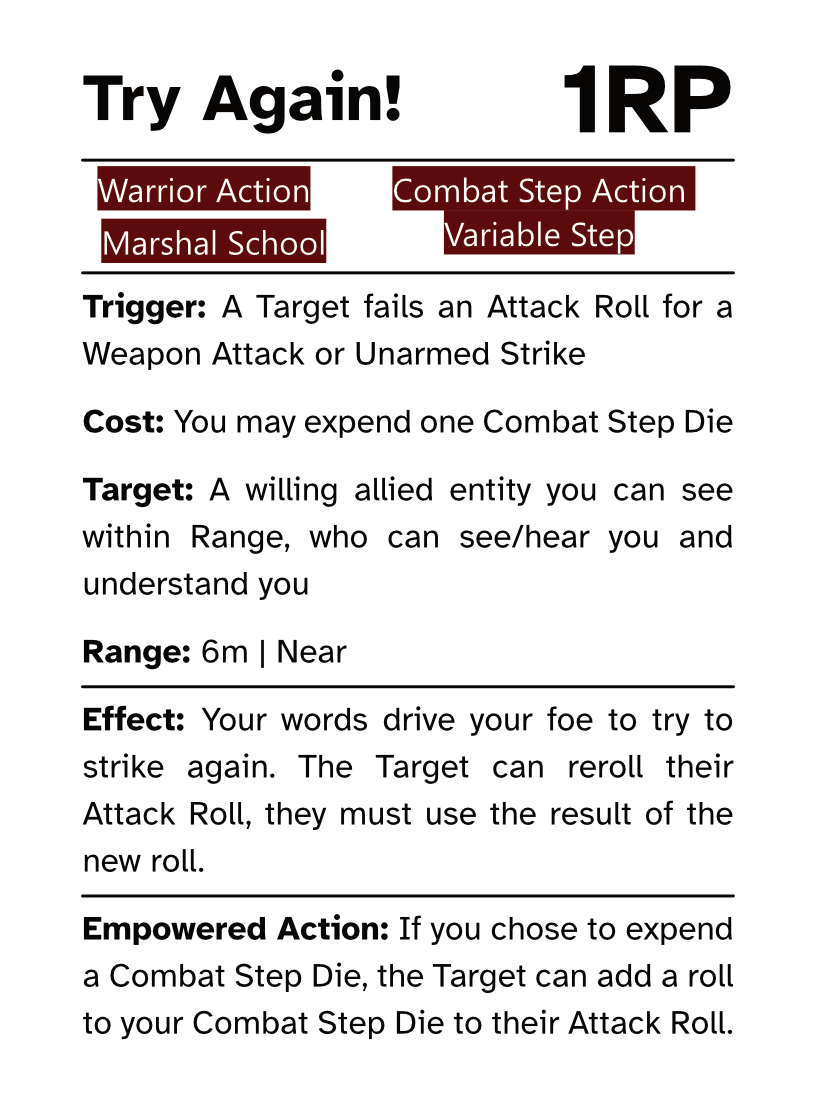
The School of the Psiknight focuses on training its warriors to channel their psionic potential into minor feats to aid them in combat. They are not true psions and their powers are far more temperamental, leading to this school acting as a minor psionic order for those who use their uncontrollable powers to modify their martial talents.
Called psiknight, warriors who train in the school are rarely found in sufficient numbers for groups to form, instead many who are sufficiently trained will wander the world, looking for others in need of training. As those untrained in the use of their psionic powers run the risk of catastrophic damage from a loose thought or emotional outburst, potentially causing harm or worse to not only the psionic individual but to those closest to them. Leading to psikight bands comprising of a mentor and one or two students.
1st Tier Psiknight Feature
You have been trained in skills useful for the road and psionics. Choose two Skills from Cosmology, Empathy, Focus, Magical Lore, Nature, Perception, and Survival. You Learn the chosen Skills and then can choose one of the listed Skills you have Learnt to Master.
You gain the Spellcaster and Psionics Class Tags, and Learn the Psiblade Form 1 - Determination Combat Step Action.
1st Tier Psiknight Feature
Your training builds upon your innate talents in channelling your psionic powers. See the Magic Chapter for the general rules of spellcasting, psionics, and for the Psionic Power List.
Power List: Psionic
Manifesting Trait: Your Knowledge
Power TG: 8 + your SB + your Manifesting Trait
Power Attack Modifier: Your SB + your Manifesting Trait
The following exceptions to the rules presented in the Magic Chapter are as follows:
The number of powers you can Prepare equals Manifesting Trait + half your Warrior Level (minimum of 1).
You may Prepare powers from the Psionic Power List, though you treat all powers with the Biomancy and/or Telekinesis Power Tags, with the exception of Azure Form powers, as being part of the Psionic Power List for you.
You do not start with a fixed number of Psi Points, instead at any point during your Turn you can expend and roll a Combat Step Die.
The result of your Combat Step Die + your SB is how many Psi Points you have to use until the start of your next Turn.
At which point, you gain BP equal to the amount of Psi Points you have left, once you have gained the BP the Psi Points are lost.
Whenever you manifest a Talent with the Biomancy and/or Telekinesis Power Tags using the Manifest Combat Step Action, if you have performed at least 3 Combo Step Actions during the current Combat Step Flow, you may use their Amplified ability.
Your psionics enhances your combat step actions. You may use Knowledge instead of Physique for calculating your Combat Step TG.
You may instead of expending a Combat Step Die for a Combat Step Action, choose to expend 3 Psi Points to fulfil the Cost.
Your Psi Limit and Talents Known are as follows:
| Level | Talents Known | Psi Limit |
|---|---|---|
| 1st | 2 | 1 |
| 2nd | 2 | 1 |
| 3rd | 2 | 1 |
| 4th | 2 | 1 |
| 5th | 2 | 2 |
| 6th | 2 | 2 |
| 7th | 2 | 2 |
| 8th | 2 | 2 |
| 9th | 3 | 3 |
| 10th | 3 | 3 |
| 11th | 3 | 3 |
| 12th | 3 | 3 |
| 13th | 3 | 4 |
| 14th | 3 | 4 |
| 15th | 4 | 4 |
| 16th | 4 | 4 |
| 17th | 4 | 5 |
| 18th | 4 | 5 |
| 19th | 4 | 5 |
| 20th | 4 | 5 |
2nd Tier Psiknight Feature
You have learnt how best to keep going further than normal. You gain Psychic Resistance, and an additional Combat Step Die. When you would gain a Scar Concept you immediatley gain Psi Points dependent on the Severity of Scar Concept gained, for Mild Scar Concepts you gain Psi Points equal to half your SB, for Moderate Scar Concepts you gain Psi Points equal to your SB, and for Severe Scar Concepts you gain Psi Points equal to double your SB. These Psi Points are lost at the end of your next Turn.
In addition, you gain the Psionic Recovery action.

You may perform this action a number of times up to half your Skill Bonus, replenishing expended uses upon completing a Short or Long Rest.
3rd Tier Psiknight Feature
You have learnt to channel your pain to strengthen your powers. So long as you have the Bloodied condition, you have Advantage on Power Attack Rolls, and Targets have Disadvantage on Trait Tests to resist or avoid your powers.
So long as you have the Desperation condition, all effects that generate you Psi Points or replenish Combat Step Die, double the amount of Psi Points generated and Combat Step Die restored, and your Manifest Combat Step Action does not increase its AP cost for repeated uses during a Turn.
You gain two additional Combat Step Dice, and increase the number of Combat Step Actions you know by 2.
4th Tier Psiknight Feature
What few realise is that those who tread down this school do not gain their powers from the Thoughweb but instead gained their powers due to exposure to the powers of the Outside. You gain the following benefits:
You gain the Outside-Touched Template and one additional Template Feature from it. If you already have this Template instead gain two Outside-Touched Template Features.
You count as one Size Category larger when determining your Reach.
Your Psyhic Bleed damage does not ignore BP. At the start of each of your Turns, you generate Psi Points equal to your Degrees of Psychic Bleed, these are lost at the start of your next Turn.
If you roll a 1 or a 2 on your Combat Step Die for determining how many Psi Points you generate in a Turn; you can choose to reroll the die. However, you must use the new result.
When you would gain a Scar Concept, until the end of your next Turn, you gain an Mutation Bonus to your HT based on the Severity of Scar Concept gained; Mild Scar Concept = +1 Bonus, Moderate Scar Concept = +3 Bonus, and a Severe Scar Concept = +5 Bonus.


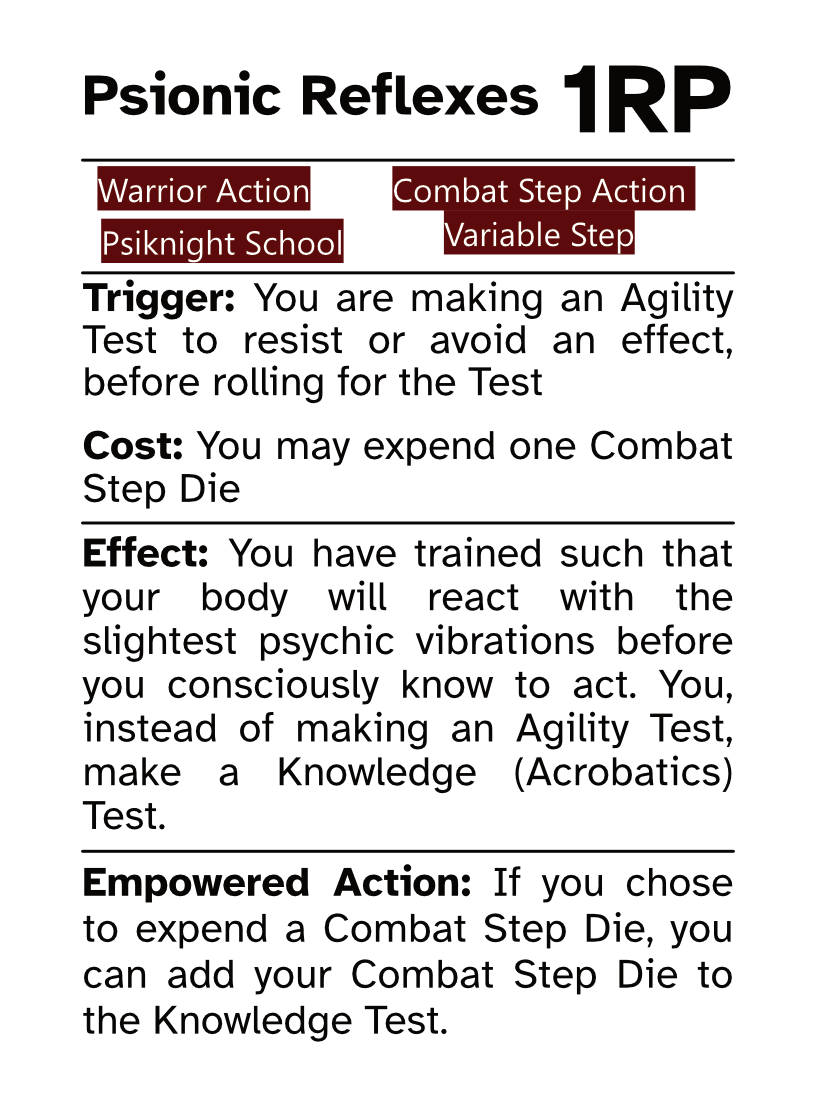


The School of the Queen’s Guard focuses on closing the distance with ranged attackers and protecting their allies. This school was founded by an order who swore to protect their queen no matter the cost, the style eventually left the nation to spread across the world. These warriors are masters of the gunblade, allowing them to be comfortable fighting at a distance and up close.
Called guardians, warriors who train in the school are found both amid the battlefield harrying the lines of enemy fusiliers, but also as bodyguards to nobles and royalty they are sworn to serve.
1st Tier Guardian Feature
You have been trained in skills useful for both protecting others and in combat. Choose two Skills from Diplomacy, Empathy, Medicine, Perception, Survival, and Technology. You Learn the chosen Skills and then can choose one of the listed Skills you have Learnt to Master.
1st Tier Guardian Feature
You are quick on the defence. You can add your Skill Bonus to Initiative Tests, and gain the Charge Rounds action.

1st Tier Guardian Feature
You swear to protect your charge. You can perform the Fighter’s Mark action with the following alterations:
2nd Tier Guardian Feature
You are skilled at merging the flow of your actions one into another. When you successfully hit with a melee attack from your Gunblade, you can immediately reload your Gunblade if it has the Loading Weapon Property or up to six rounds of the Gunblade if it has Loading (X) Weapon Property, this reloading if taken immediately costs 0AP.
If you hit with a ranged attack using your Gunblade, you can perform the Charge Rounds action for 0AP immediately after it.
The Charge Rounds action can be performed multiple times in a Turn, when they are 0AP due to this Feature, without increasing their AP cost for multiple uses in a Turn.
3rd Tier Guardian Feature
You know how to maintain your momentum in battle. When an entity Marked by you is reduced to 0HP, you regain the use of one expended Combat Step Die.
At the end of an Encounter/Scene in which you and an entity with your Sworn to Protect condition were involved in a combat. If the entity you had given the Sworn to Protect condition had not received any Degrees of the Wounded condition, you replenish a number of expended uses of your Combat Step Dice equal to half the number of Rounds of the Encounter (minimum of 2).
The Charge Rounds action changes to add Necrotic and Radiant damage to the list of Damage Types you can choose between.
4th Tier Guardian Feature
You can keep fighting past near lethal damage. When you score an Inspired Event, you may remove one Mild Scar Concept or reduce a Moderate to a Mild Scar Concept.
When you score an Overwhelming Blow with your Gunblade, the X value of the Explosive Weapon Property is doubled, whereas if your score a Critical Hit with the Gunblade, the value of X is tripled.
You can choose for any number of entities to be unaffected by the Explosive Weapon Property of your Gunblade.
You gain the Arcane Burst reaction.

Once you have used this reaction, you cannot do so again until you have completed a Short or Long Rest.


The School of the Spellblade focuses on training its warriors to channel their arcane potential into minor feats to aid them in combat. They either have chosen not to study the arcane art to the same level as a loremaster or arcanist, or it may be the student doesn’t have the arcane potential to be able to manifest such ability. No matter the reason those from this school have focused instead on using their magic to augment their combat abilities to great effect.
Called spellblades, warriors who train in the school can be found as elite units on the battlefield or in the employ of nobles or royalty as specialist guards. Spellblades may also be found in magic focused organisations as security or providing protection for its members.
1st Tier Spellblade Feature
You have been trained in skills useful for the road and psionics. Choose two Skills from Cosmology, Empathy, Focus, Investigation, Magical Lore, and Perception. You Learn the chosen Skills and then can choose one of the listed Skills you have Learnt to Master.
You gain the Spellcaster and Cosmic Magic Class Tags.
1st Tier Spellblade Feature
You funnel your magic into this weapon making it an extension of you being. When you complete a Short or Long Rest, you can select a Simple or Martial melee Weapon you are Trained in the use of. This Weapon until you change your choice becomes your Spellblade. Spellblade’s gain the following additional abilities:
You can choose to use your Knowledge Trait for Attack and Damage Rolls with this Weapon, and to calculate your Combat Step TG.
The Weapon cannot be removed from your grasp unless you are Incapacitated.
A Spellblade is considered a Magical Weapon for overcoming Damage Reductions, Resistances, and Immunities to Non-Magical Weapons.
If you apply the Cosmic Blade Cantrip to your Spellblade, you can replace the Weapon’s Damage Type to match the Damage Type chosen for the Cantrip.
You can infuse this Weapon with a Cantrip that requires an Attack Roll, reducing the AP cost of casting the Cantrip by 1 AP (to a minimum of 1 AP).
The Cantrip becomes stored in the Spellblade until you successfully hit with the Spellblade as part of a Weapon Attack. The Weapon deals its normal damage, though you can choose to replace its Weapon’s Damage Type with that dealt by the Cantrip.
The Cantrip will simultaneously hit the Target, resolving as if you had made a successful Attack Roll during its casting.
A Spellblade can only be infused with one Cantrip at a time, if you infuse it with a second Cantrip the first is lost.
If the Weapon you choose is applicable for Two-Weapon Fighting, you can select during the Rest to instead select two Weapons, so long as they both meet the requirements for Two-Weapon Fighting, to be your Spellblades. If you do this both Spellblades are considered a Weapon Group. A Weapon Group means it only counts as one Use Item interaction to Draw or Sheath both Weapons at once.
1st Tier Spellblade Feature
Your training builds upon your innate talents in channelling cosmic magic for your spellcasting. See the Magic Chapter for the general rules of spellcasting and for the Cosmic Spell List.
Spell List: Cosmic
Spellcasting Trait: Your Knowledge
Spell TG: 8 + your SB + your Spellcasting Trait
Spell Attack Modifier: Your SB + your Spellcasting Trait
Spellcasting Focus: Melee Weapons
The following exceptions to the rules presented in the Magic Chapter are as follows:
The number of spells you can Prepare equals Spellcasting Trait + half your Warrior Level (minimum of 1).
You may Prepare spells from the Cosmic Spell List, though you treat all spells from the Abjuration and Protection Spell Schools as being part of the Cosmic Spell List for you.
Your Spell Slots and Cantrips Known are as follows:
| Spell Slots per | Spell Circle | ||||
|---|---|---|---|---|---|
| Level | Cantrips | 1st | 2nd | 3rd | 4th |
| 1st | 2 | 2 | - | - | - |
| 2nd | 2 | 2 | - | - | - |
| 3rd | 2 | 2 | - | - | - |
| 4th | 2 | 3 | - | - | - |
| 5th | 2 | 3 | - | - | - |
| 6th | 2 | 3 | - | - | - |
| 7th | 2 | 4 | 2 | - | - |
| 8th | 2 | 4 | 2 | - | - |
| 9th | 2 | 4 | 2 | - | - |
| 10th | 3 | 4 | 3 | - | - |
| 11th | 3 | 4 | 3 | - | - |
| 12th | 3 | 4 | 3 | - | - |
| 13th | 3 | 4 | 3 | 2 | - |
| 14th | 3 | 4 | 3 | 2 | - |
| 15th | 3 | 4 | 3 | 2 | - |
| 16th | 3 | 4 | 3 | 3 | - |
| 17th | 3 | 4 | 3 | 3 | - |
| 18th | 3 | 4 | 3 | 3 | - |
| 19th | 3 | 4 | 3 | 3 | 1 |
| 20th | 3 | 4 | 3 | 3 | 1 |
2nd Tier Spellblade Feature
You have learnt to enhance your attack with your magic. Your Spellblade increases any Magic Bonus to Attack and Damage Rolls by 1.
Once per Turn, upon hitting a Target with your Spellblade, you may expend one unexpended Spell Slot. If you do so, add a number of rolls of your Combat Step Die to the Damage Roll, equal to the Circle of the expended Spell Slot, this does not expend any uses of the Combat Step Dice.
After damage has resolved the Target, so long as they are no more than one Size Category larger than you (maximum Gargantaun), must make a Physique Test against your Spell TG. If the Spellblade has the Force Weapon Focus Property, the Target makes the Physique Test with Disadvantage and this can affect a Target no more than two Size Categories larger than you (maximum Gargantaun).
Failed Test: The Target is knocked Prone.
3rd Tier Spellblade Feature
Mobility is important for survival on the battlefield. When you hit a Target with a Weapon Attack made using your Spellblade, until the start of your next Turn, the Target has Disadvantage on Trait Tests made to resist, avoid, or end the effects of your spells.
You gain the Arcane Janut action.

You may use this action a number of times up to your Skill Bonus, replenishing expended uses upon completing a Long Rest.
4th Tier Spellblade Feature
You have mastered the use of your spellblade. The AP cost increase for using the Cast action multiple times in a Turn, does not count the uses of the action to infuse a spell into your Spellblade. Using the Cast Combat Step Action, to infuse a spell into your Spellblade, also ignores the AP cost increase for using the action multiple times in the same Turn.
You can now infuse your Spellblade with a spell of 4th-Circle or lower that requires an Attack Roll, this acts the same way as with Cantrips per the Spellblade Feature.


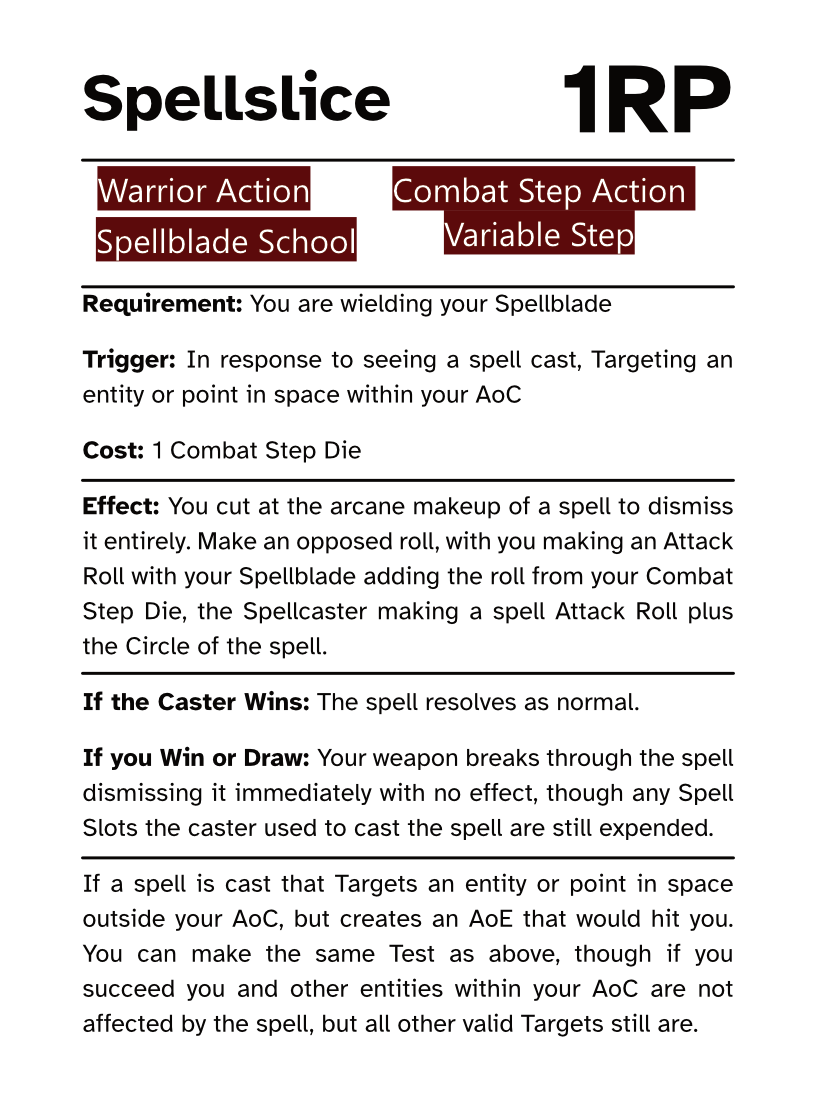


The School of the Spellshot focuses on training its warriors to channel their arcane potential into their ammunition to aid them in combat. These warriors do not have the arcane potential to create spells beyond the simplest cantrip. However, they have found themselves more than capable of channelling their magic into their ammunition for more interesting effects.
Called spellshots, warriors who train in the school can be found travelling the world, selling their skills to those who need them most, or offering aid to those in need.
While this school is themed around arcane potential, you can choose this school to instead represent more technological ranged fighters, using ammunition enhanced by technology for unique effects.
1st Tier Spellshot Feature
You have been trained in skills useful for a travelling spellshot. Choose two Skills from Acrobatics, Focus, Magical Lore, Nature, Perception, Survival, and Technology. You Learn the chosen Skills and then can choose one of the listed Skills you have Learnt to Master.
You gain the Spellcaster, Cosmic Magic, and Primordial Magic Class Tags.
1st Tier Spellshot Feature
Your training builds upon your innate talents in channelling cosmic and primordial magic for your spellcasting. See the Magic Chapter for the general rules of spellcasting and for the Cosmic and Primordial Spell Lists.
Spell List: Cosmic & Primordial
Spellcasting Trait: Your Knowledge or Intuition (chosen upon gaining this Feature)
Spell TG: 8 + your SB + your Spellcasting Trait
Spell Attack Modifier: Your SB + your Spellcasting Trait
Spellcasting Focus: Ranged Weapons
The following exceptions to the rules presented in the Magic Chapter are as follows:
You do not Learn any spells other than Cantrips nor do you gain Spell Slots.
You can Learn a number of Cantrips as shown in the “Cantrips Known” column of the Table below, you can choose any combination of Cantrips from the Cosmic and Primordial Spell Lists.
| Level | Cantrips |
|---|---|
| 1st | 2 |
| 2nd | 2 |
| 3rd | 3 |
| 4th | 3 |
| 5th | 3 |
| 6th | 3 |
| 7th | 3 |
| 8th | 3 |
| 9th | 4 |
| 10th | 4 |
| 11th | 4 |
| 12th | 4 |
| 13th | 4 |
| 14th | 4 |
| 15th | 5 |
| 16th | 5 |
| 17th | 5 |
| 18th | 5 |
| 19th | 5 |
| 20th | 5 |
1st Tier Spellshot Feature
You funnel your magic into your ammunition. When using a ranged Weapon that you are Trained in the use of, and that requires Ammunition, you gain the following benefits:
You can choose to use your Spellcasting Trait for Attack and Damage Rolls with this Weapon, and Combat Step TG.
Ranged Weapon Attacks made with this Weapon increase their Critical Hit Scope by 1.
Ranged Weapon Attacks made with this Weapon are considered magical for overcoming Damage Reductions, Resistances, and Immunities to Non-Magical Weapons.
If this Weapon has the Loading Weapon Property you can ignore it.
If the Weapon has the Loading (X) Weapon Property you can load 2 pieces of Ammunition for each 1AP used to reload it.
All Ammunition loses its magic upon hitting or missing the Target of the attack.
2nd Tier Spellshot Feature
You have learnt how to infuse your Ammunition with your Cantrips. You can Infuse your Ammunition with a Cantrip that requires an Attack Roll, reducing the AP cost of casting the Cantrip by 1 AP (to a minimum of 1 AP).
The Cantrip becomes stored in the Ammunition until you successfully hit with the Ammunition as part of a ranged Weapon Attack. The Weapon deals its normal damage, though you can choose to replace its Weapon Damage Type with that dealt by the Cantrip.
The Cantrip will simultaneously hit the Target resolving as if you had made a successful Attack Roll during its casting.
Ammunition can only be Infused with one Cantrip at a time, if you Infuse it with a second Cantrip the first is lost.
You can maintain Infusions for an amount of Ammunition equal to your SB. If you Infuse more Ammunition with Cantrips than this limit, each time you must select a piece of Ammunition to lose its Infusion.
3rd Tier Spellshot Feature
You have learnt to maintain a link to the magic in your ammunition to move the ammunition in the air to guarantee a hit. When you make an Attack Roll with a ranged Weapon that uses Ammunition and miss, you can expend a Combat Step Die to reroll the Attack Roll against a different Target within 12m (At Range) of the original Target, adding your Combat Step Die to the new Attack Roll.
You gain two additional Combat Step Dice and increase the number of Combat Step Actions you know by 1.
4th Tier Spellshot Feature
You know how to make the most out of your spellshots. Your Inspired Event scope for Attack Rolls made with a ranged Weapon that uses Ammunition increases by 1.
If you score a Critical Hit with a Weapon Attack from a ranged Weapon that uses Ammunition, you regain a use of your Combat Step Die and the Target gains three Degrees of the Burned (X) condition. Each time you score the Critical Hit, you can choose one of the following Damage Types for the Burned condition to use; Acid, Cold, Fire, Force, Lightning, Necrotic, Poison, Radiant, Thunder, or Vorpal.
In addition, your Infused Shot Feature now allows you to infuse one of your Spellshot School Combat Step Actions with the name “X Shot” into your Ammunition instead of a Cantrip, following the same steps. On a hit both the Infused Combat Step Action’s “On a Hit” effect occurs in addition to the normal effect of the Hit. You can only infuse one Combat Step Action this way at a time, you may infuse one Cantrip and one Combat Step Action into a piece of Ammunition at a time.
When you infuse a Cantrip into your Weapon. You may replace the size of the Weapon’s base damage die with that of the Infused Cantrip if it is larger. On a Critical Hit with this Weapon, the size of the Cantrip’s damage dice is increased in size to that of your Combat Step Die.


The School of the Spirit focuses on training its warriors in quick and decisive forms on the battlefield, calling upon their wealth of experience and awareness of the battlefield to bring about victory. The school however also teaches its warriors to focus on their mental and spiritual health, and how to bring for that same experience and awareness in your dealing with people and the arts. These warriors are taught to train in the arts and in politics, that they can find peace and rest when not called to fight.
Called blade masters, warriors who train in the school are found on the battlefield in the thick of combat, striking with clarity and focus no matter how thick the fog of war. They can also be found engaging in politics and practising the arts, this fact leads many noble families to send their children to learn this school of combat.
1st Tier Blade Masters Feature
You have been trained in skills useful for both on and off of the battlefield. Choose two Skills from Diplomacy, Empathy, Focus, General Knowledge, Perception, and Performance. You Learn the chosen Skills and then can choose one of the listed Skills you have Learnt to Master.
You also are Trained in the use of any combination of two Artisan Tools or Musical Instruments.
1st Tier Blade Masters Feature
You can pour your focus and determination into activities outside of combat. Your Inspired Event scope increases by 1. When you score a Critical Hit, you gain BP equal to your Warrior Level.
You may use Intuition instead of Physique or Agility for Weapon Attack and Damage Rolls, and calculating your Combat Step TG.
When you make a Determination Trait Test, bar Attack Rolls, or a Trait Test using Artisan Tools or Musical Instruments, you can add your Intuition to the roll.
You gain an additional Combat Step Die and increase the number of Combat Step actions you know by 3.
2nd Tier Blade Masters Feature
You can strike with your blade faster than the eye can see. If you would make an Attack Roll at Advantage, you can choose to lose the Advantage on the Attack Roll. If you do so, after the attack has resolved you may take the Basic Attack Combat Step Action or take the next action in the Lotus, Melody, or Moon Combat Step Chain Actions, immediately for 0AP, this second action cannot be granted Advantage. When you use the chosen action this way it ignores AP cost increase for using the same action multiple times in a Turn.
You treat all Weapons from the Swords and Bow Weapon Groups as having the Martial Arts Weapon Property. When you would deal damage with a Weapon with the Martial Arts Weapon Property, you may choose to replace your Weapon's damage dice with your Combat Step Die.
3rd Tier Blade Masters Feature
You know how to make the most out of every combat step you perform. Whenever you complete a Finisher Combat Step Action, compare the total number of Combat Step Actions you performed as part of the completed Flow against the value of your Skill Bonus. For every Step Action taken past the value of your SB, you replenish one Combat Step Die.
You gain an additional Combat Step Die and increase the number of Combat Step actions you know by 2.
4th Tier Blade Masters Feature
You know how to make each moment count. When making an Initiative Test, you replenish one expended use of the Stay in the Fight reaction.
If you make an Attack or Damage Roll using Intuition, you can replace the Damage Type of your Weapon and your Combat Step Die with Radiant damage.
When you perform your Final Moment, you may choose to use the Soulful Strike action.


![Warrior Action Card (Combat Step - Variable Step) Desperate Struggle AP Cost: 2AP Requirement: Under the Desperation condition Cost: 1 Combat Step Die Duration: [Determination] Rounds (minimum of 1) Effect: Your desperation grants your strength to overcome your foes. For the Duration, your Physique and Intuition increases by half your SB.](../../images/Action Cards/Class Actions/warrior/desperate_struggle.png)


